Specialized Agents
Each its own LangGraph state machine
Governed Farms
Tools · Models · Memory · Knowledge · Budgets
Policy Domains
Humans encode intent as governance
Governed Skills
Versioned competencies bound to agents
What it is
Most “AI agent” tools give you a chatbot. CortexObserver gives you a governed AI workforce and a command center to run it. You speak intent — @allen deploy this CDK repo to dev, @amy build a churn model, @charles analyze NVDA — and a roster of specialists, each with its own reasoning graph, skills, and tool grants, does the work.
Every action flows through Farms (managed AI services for tools, models, memory, knowledge, and budgets) and is bounded by Governance (policies, procedures, standards, risk budgets, and human approval gates). The results — a deployed stack, a trained model, a trading thesis — render back as live truth you can see, audit, and adjust.
The circular loop — Humans define policies & budgets → Farms enforce them → Agents work within the constraints → Results flow back as live truth → Humans observe and adjust → repeat. Humans write the rules, agents do the work, every outcome renders live.
Talk to your workforce
Mission Control is the NLP command surface — type a request, @mention a specialist to dispatch, and watch each agent's LangGraph execute node-by-node with live state, approval gates, and replay.
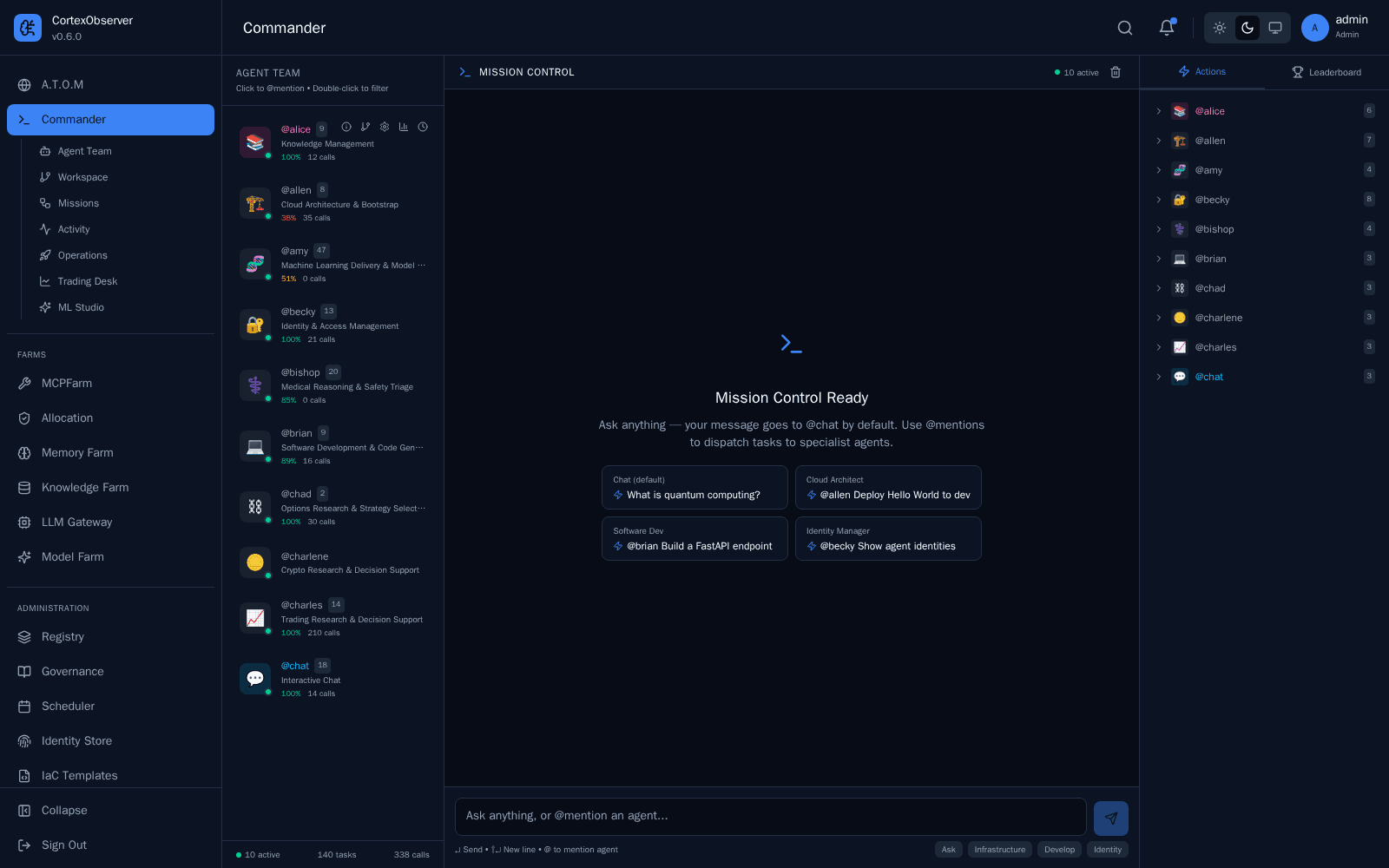
Commander — Mission Control: the natural-language command surface for the entire AI workforce
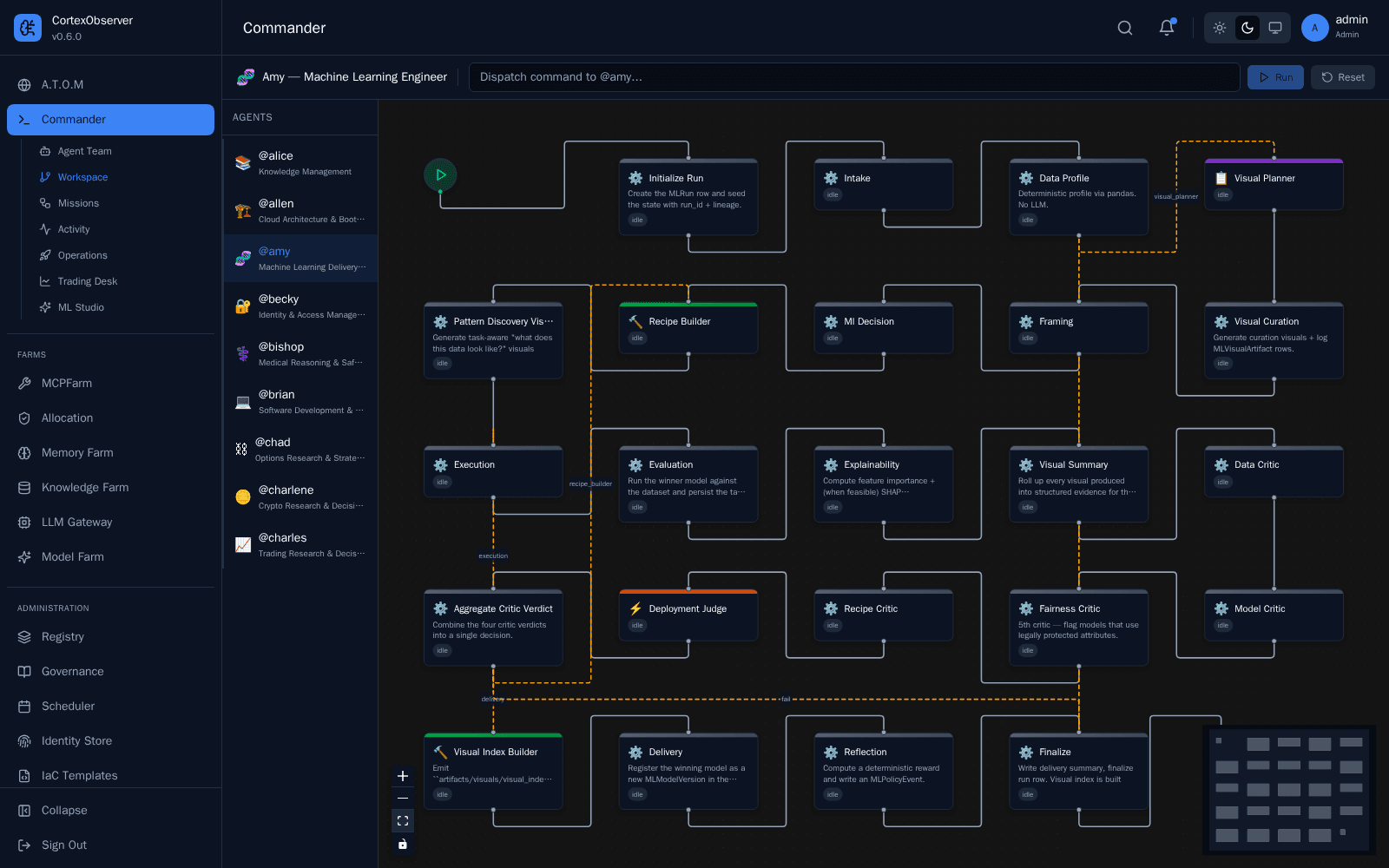
Graph Workspace — @amy's LangGraph executing node-by-node with live state
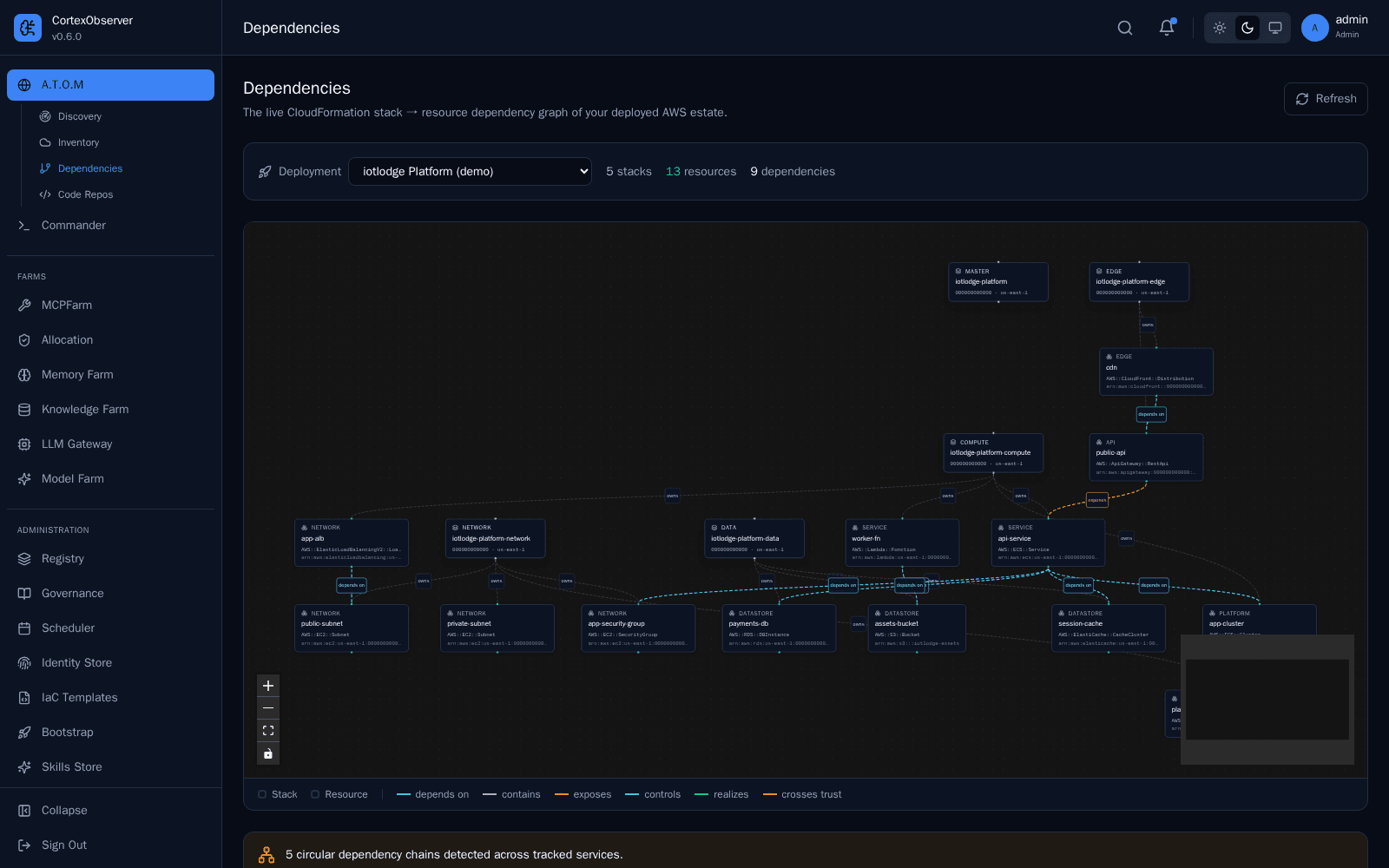
A.T.O.M — agent-deployed CloudFormation rendered as a live dependency graph
A roster of specialists
Each agent is an individual LangGraph StateGraph with role-specific nodes, skills, and tool access — governed identically whether a human or an agent is the principal.
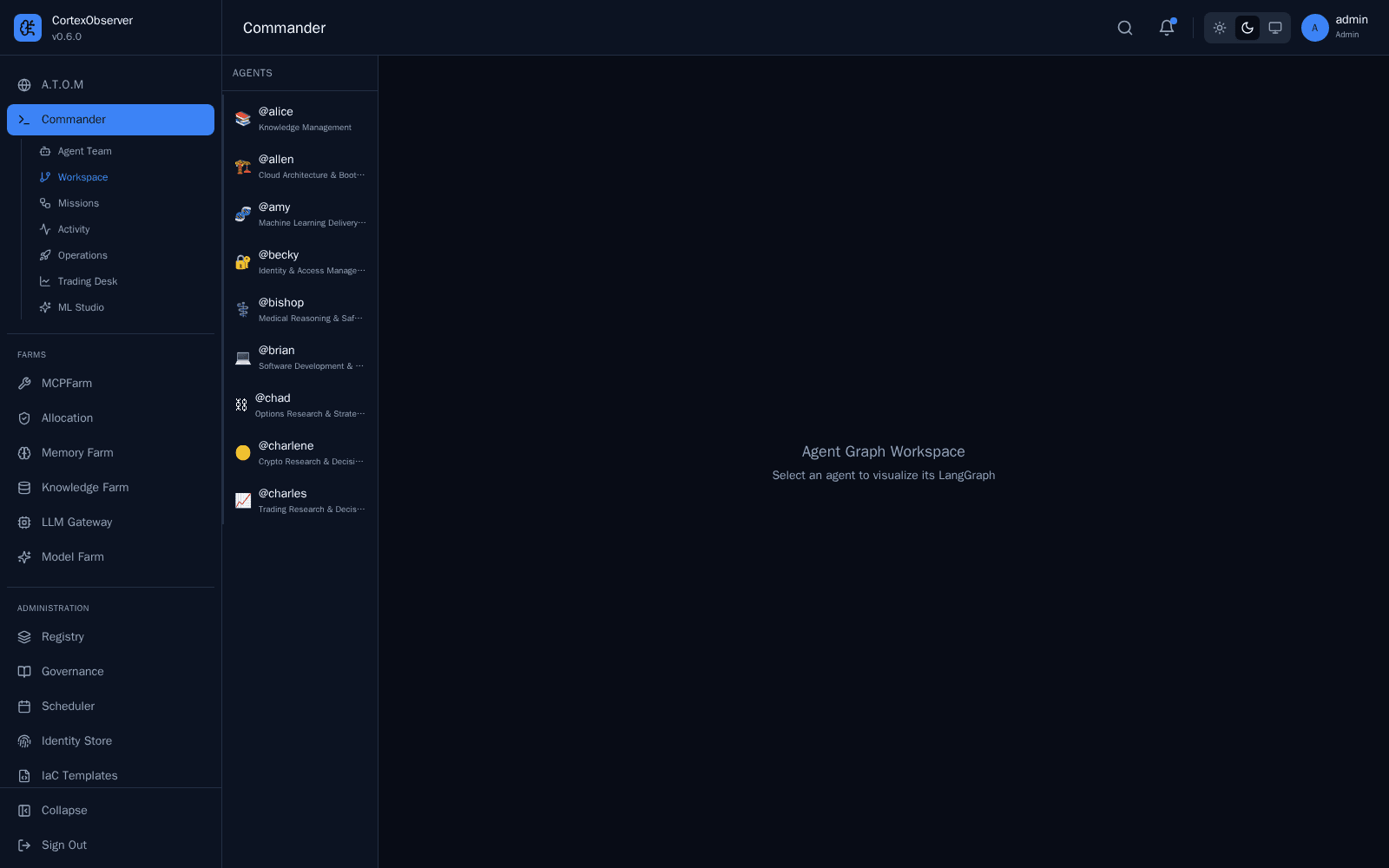
The workforce — ten specialists, each a governed reasoning graph
@allen
Cloud Architect
Clones a CDK repo → cdk synth → reads governance policy → plans → human approval → deploys → renders in the live DAG.
@amy
ML Engineer
Profiles a dataset → frames the task → trains → critics gate it → a deployment judge promotes a versioned model in the Model Farm.
@charles · @charlene · @chad
Trading Desk
Multi-agent research across stocks, crypto, and options — analyst lenses → bull/bear debate → risk debate → portfolio decision. Research only.
@brian
Software Developer
Multi-model pipeline: orchestrate (Opus) → plan (Sonnet) → build (Haiku) → validate → synthesize → persist code.
@bishop
Medical Reasoning
Risk-gated triage with hallucination and bias critics, always human-in-the-loop on consequential output.
@becky
Identity
Access management across the unified identity store — agent, human, and service principals with RBAC.
@alice
Knowledge
Governed RAG over the Knowledge Farm — source-cited retrieval with document lifecycle and model-lifecycle tools.
@chat
Assistant
General-purpose conversation — the front door to the workforce when you do not yet know who to dispatch.
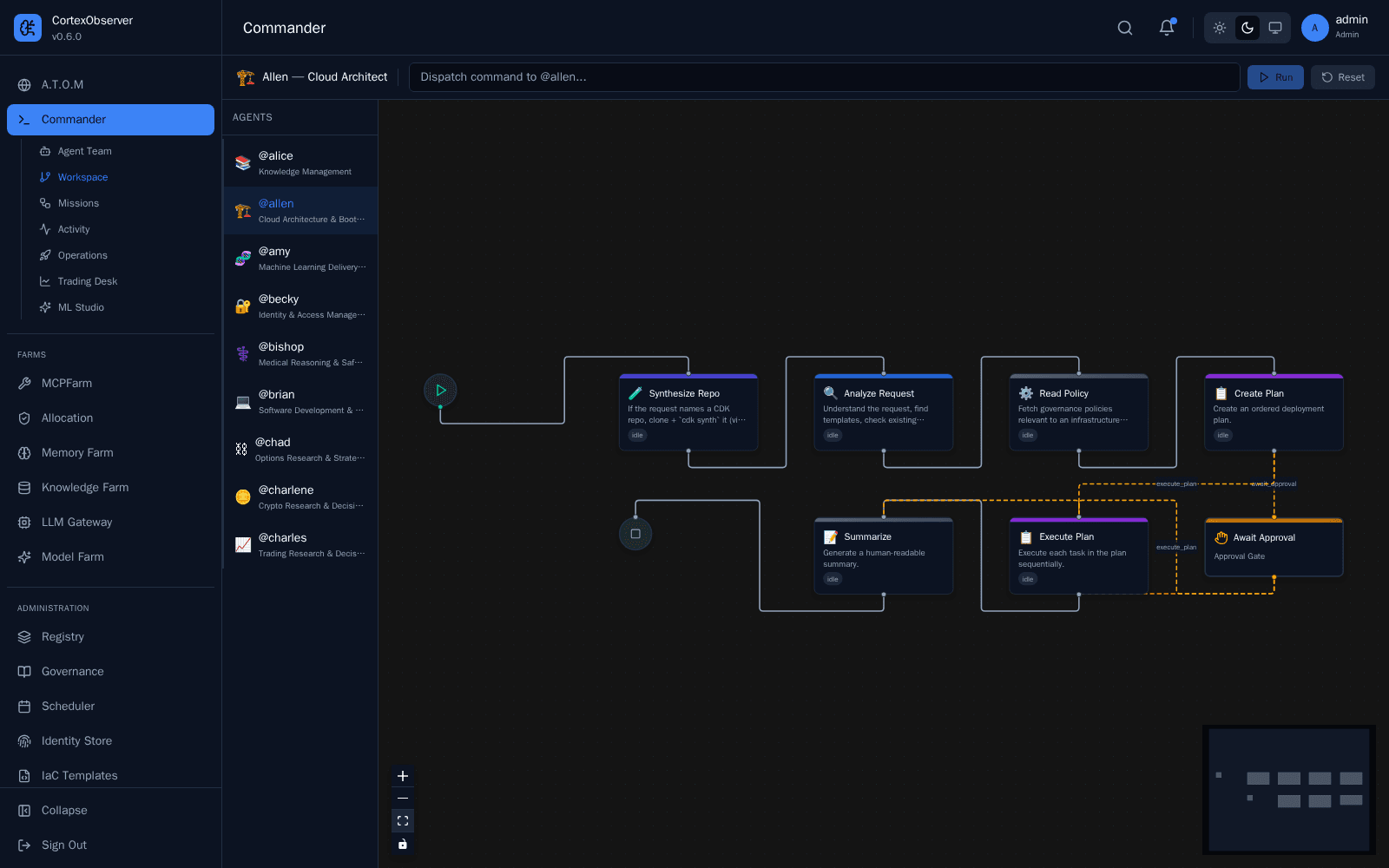
@allen — the Cloud Architect graph: synth → policy → plan → approval → deploy
@amy — the ML Engineer graph: profile → frame → train → critics → promote
A.T.O.M — live truth of your cloud estate
The Agentic Temporal Operating Model is the single pane of glass over everything in AWS: Discovery → Inventory → Dependencies. It absorbs infrastructure built outside CortexObserver via the Resource Groups Tagging API and renders agent-deployed stacks as a live dependency graph.
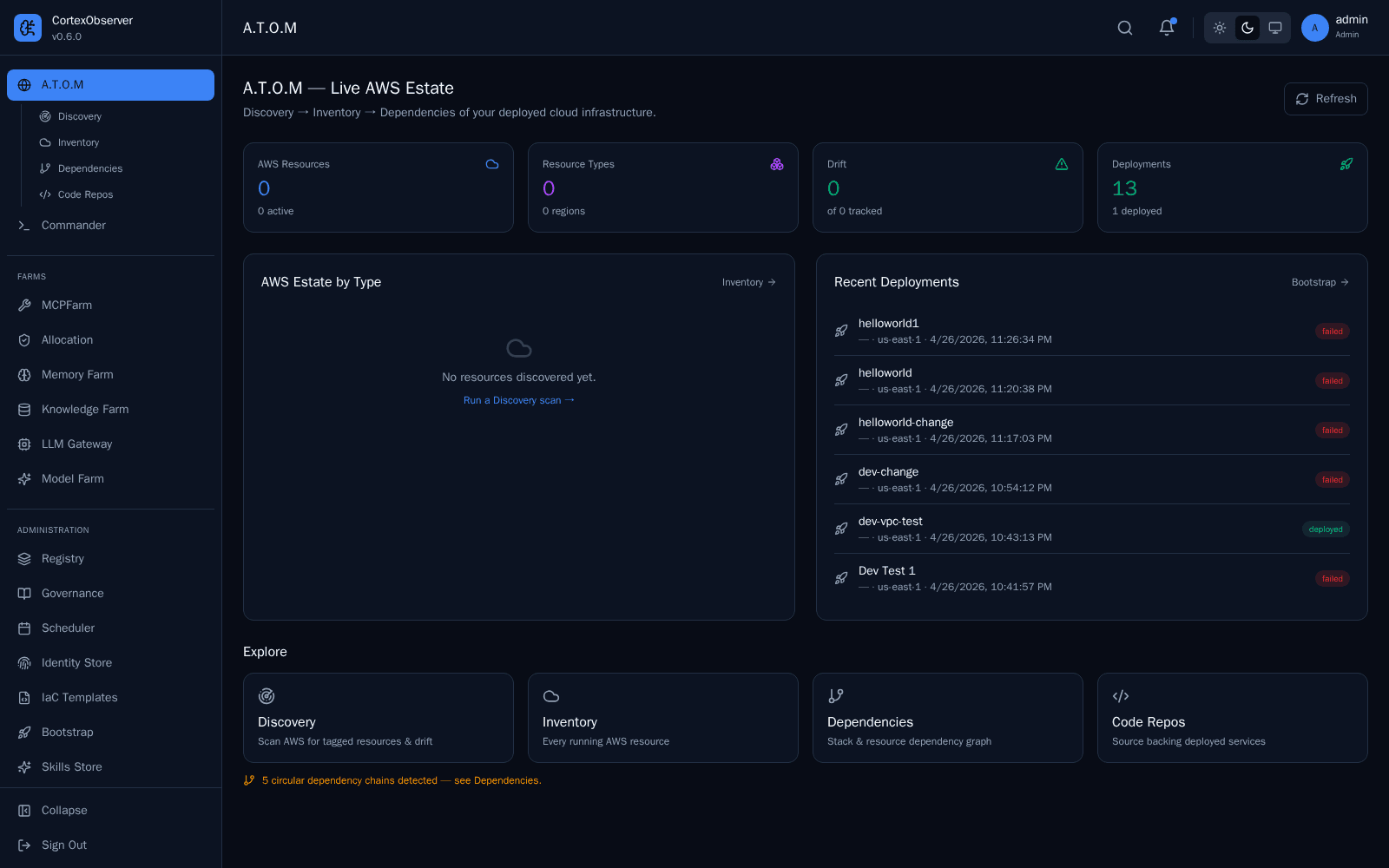
A.T.O.M Overview — discovery and inventory across the live AWS estate
Dependencies — CloudFormation/CDK resources as a live dependency DAG
The control plane — five Farms
Farms aren't just resource pools. Each is a managed AI service with its own LLM, prompts, skills, and human control UI. Agents consume Farms; humans govern them.
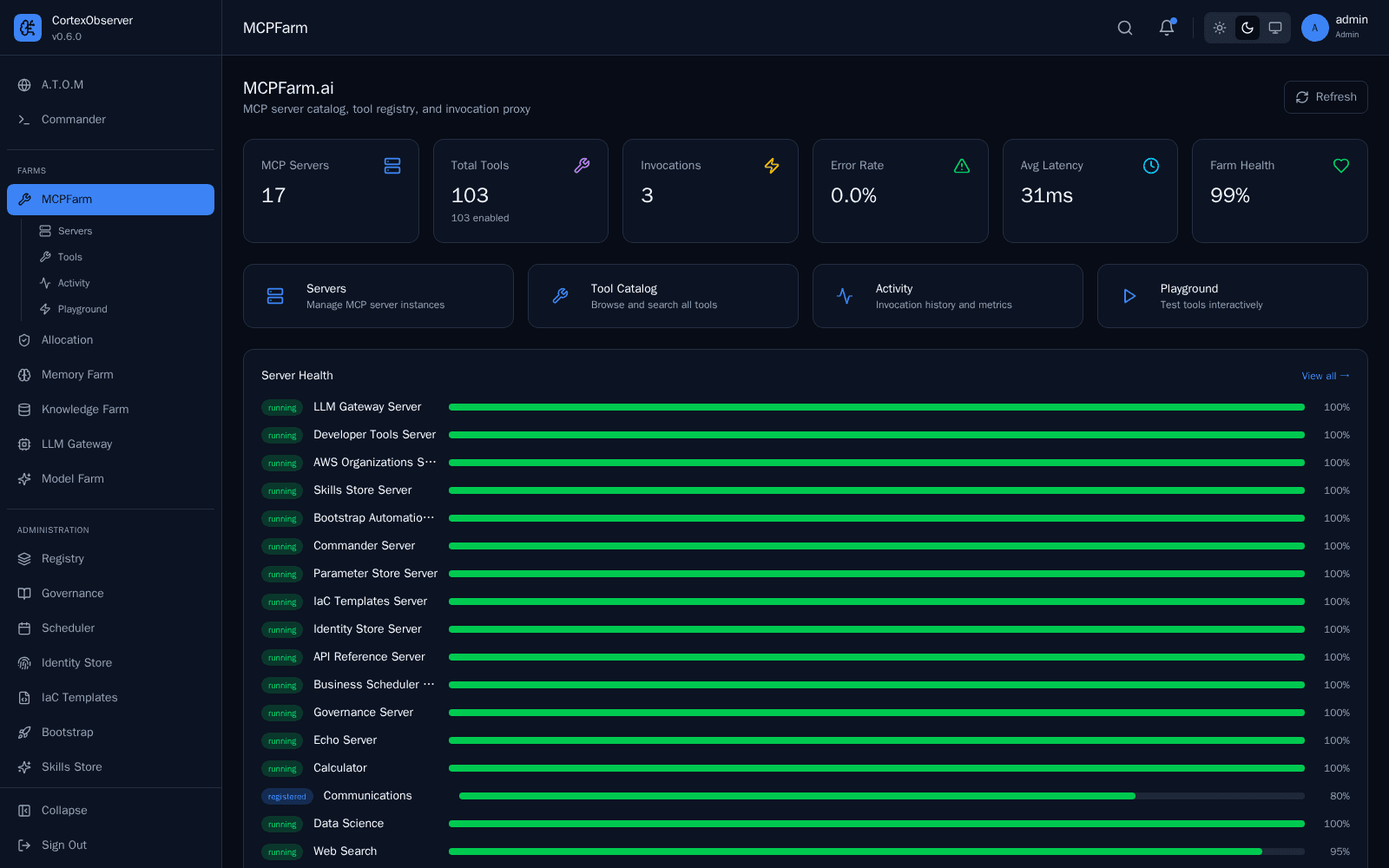
MCPFarm
Manages — 100+ tools across 17 servers, with pre-execution risk scoring and authorization.
Human control — Tool grants, server health, invocation history, and a tool playground.
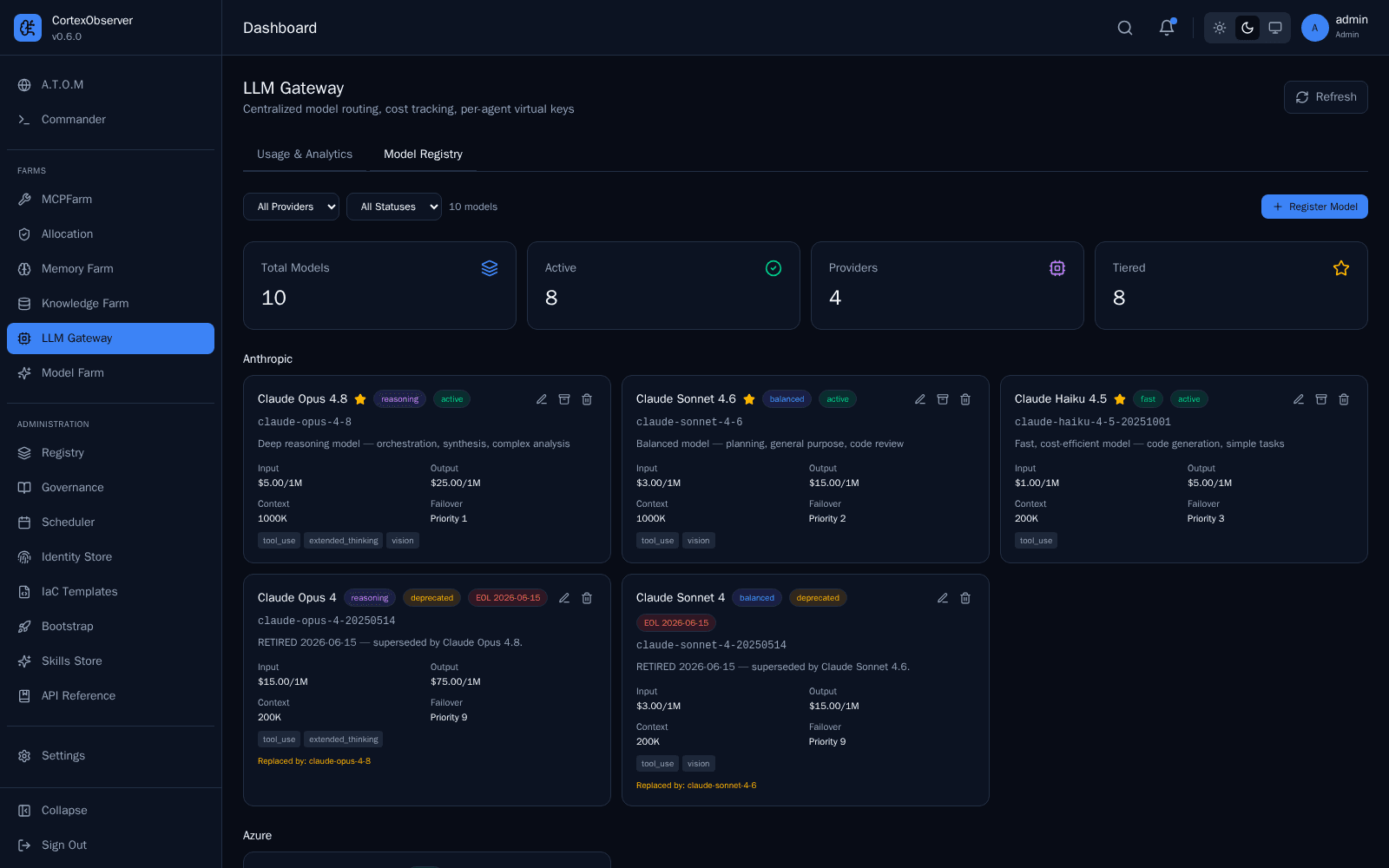
LLM Gateway
Manages — LiteLLM routing, a multi-provider model registry, tiers, failover, and cost tracking.
Human control — Model lifecycle (active → deprecated → EOL), per-agent budgets, and usage analytics.
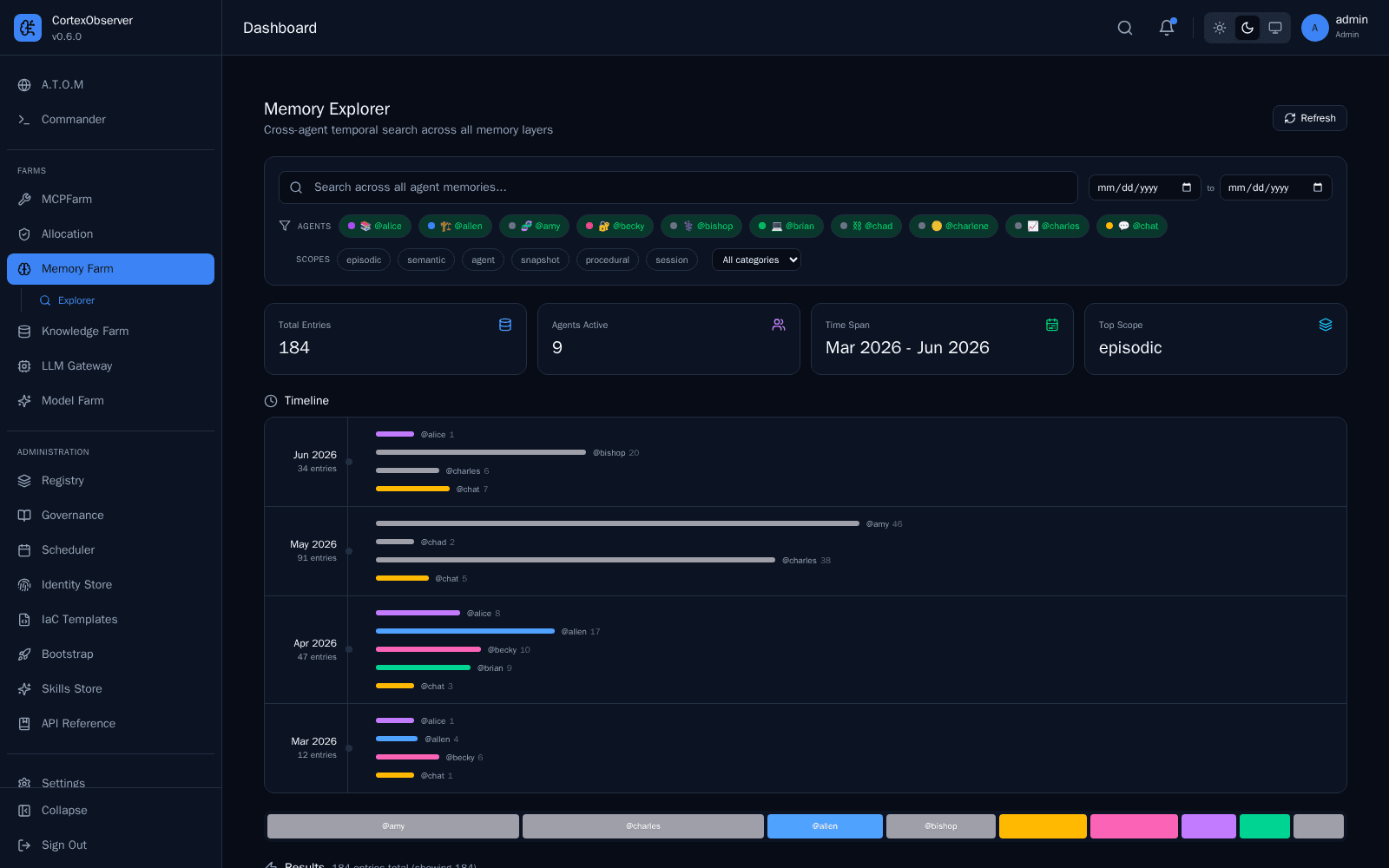
Memory Farm
Manages — Four-tier agent memory: L1 Redis → L2 Postgres → L3 snapshots → L4 procedural.
Human control — A cross-agent Memory Explorer with temporal search, consolidation, and quotas.
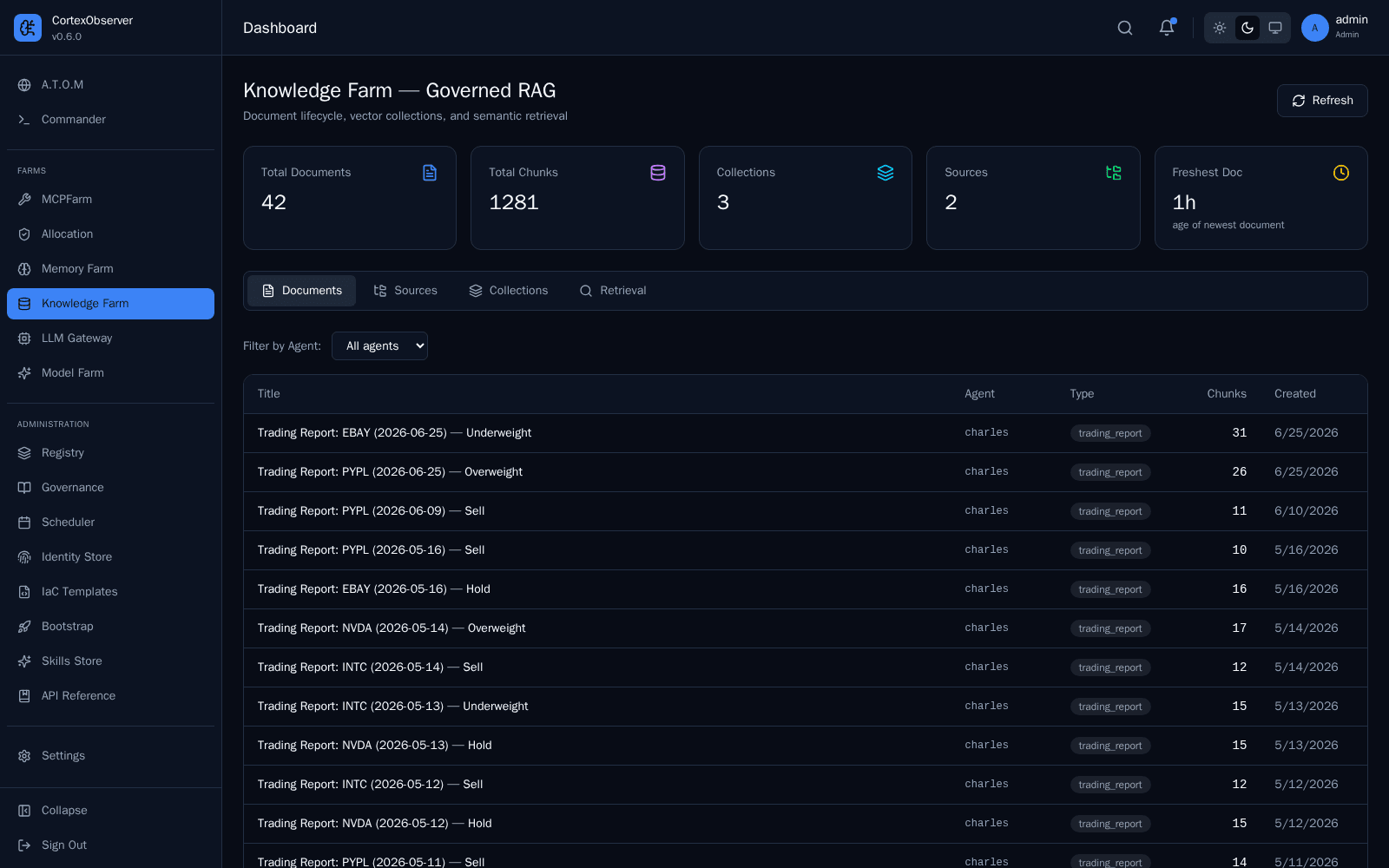
Knowledge Farm
Manages — Agent-namespaced RAG over Qdrant hybrid search (BM25 + dense + RRF).
Human control — Document lifecycle, sources, collections, and retrieval testing.
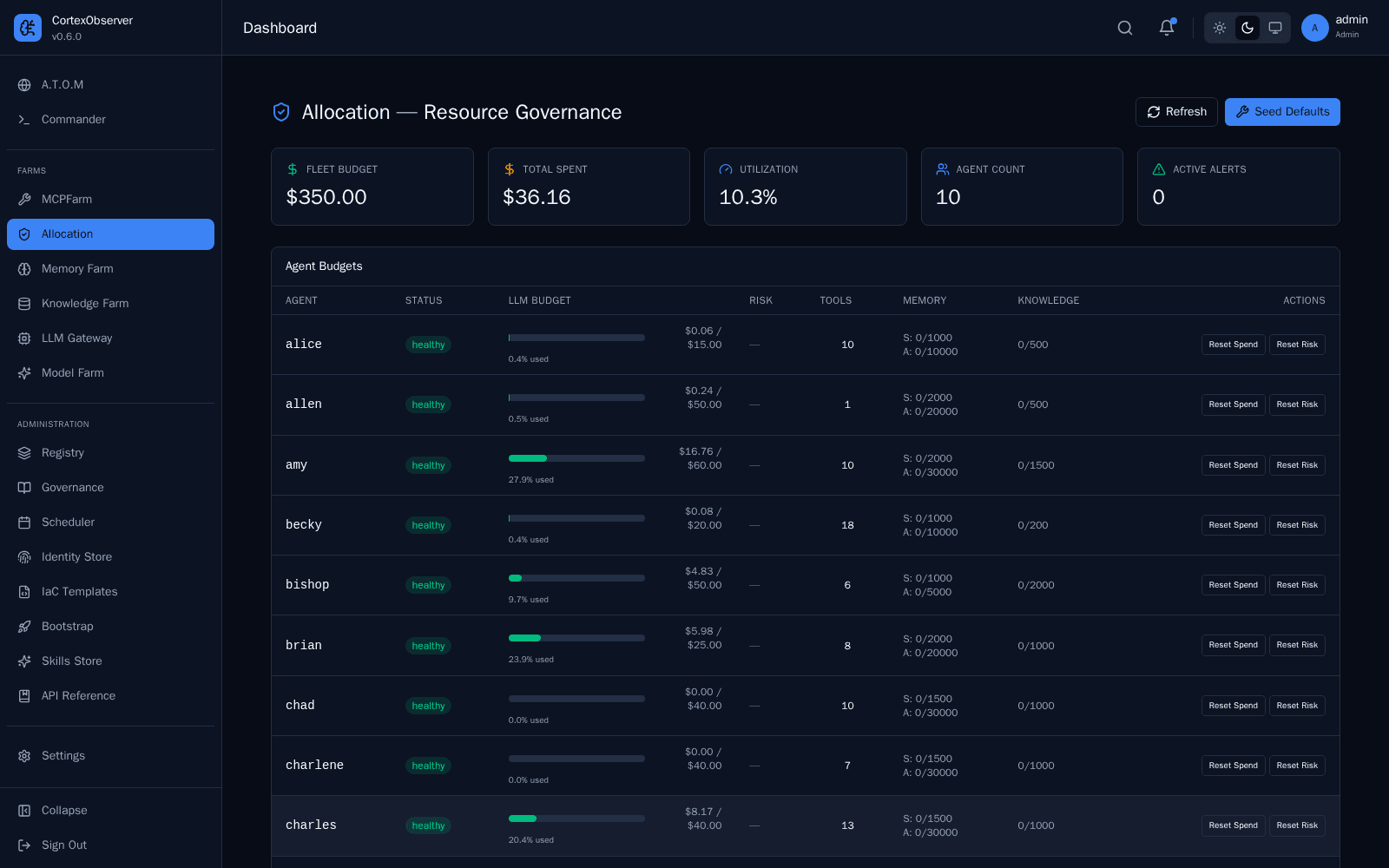
Allocation
Manages — Per-agent budgets, risk budgets, tool grants, and memory/knowledge quotas.
Human control — The enforcement table — checked before every tool call, LLM invocation, and memory write.
Governance — the boundaries
Humans encode intent as Policies, Procedures, and Standards across 19 enterprise domains. Those documents become agent Prompts, Skills, and Tools — and agent expertise is itself governed in the Skills Store.
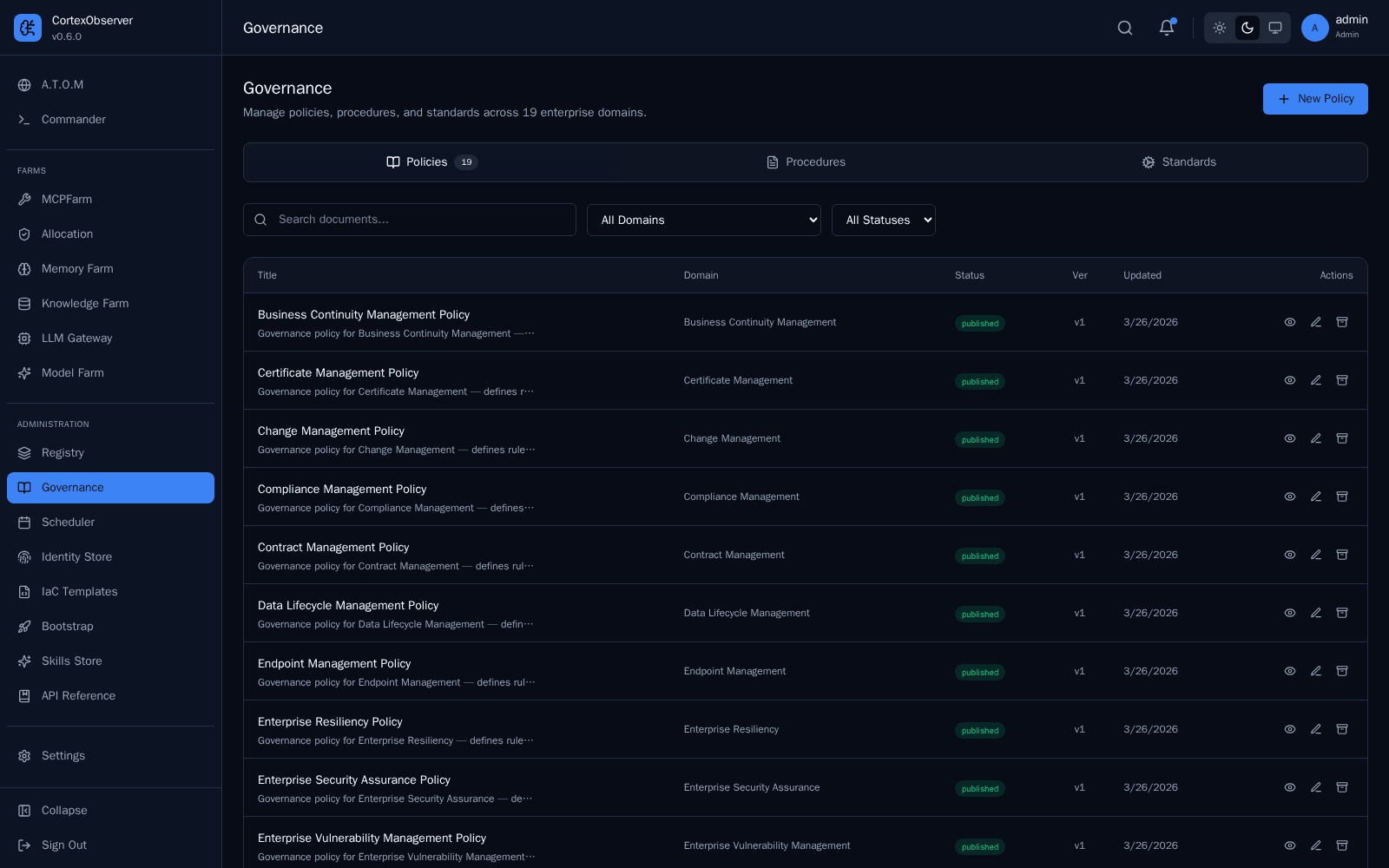
Governance — 19 published policy domains injected into agent reasoning
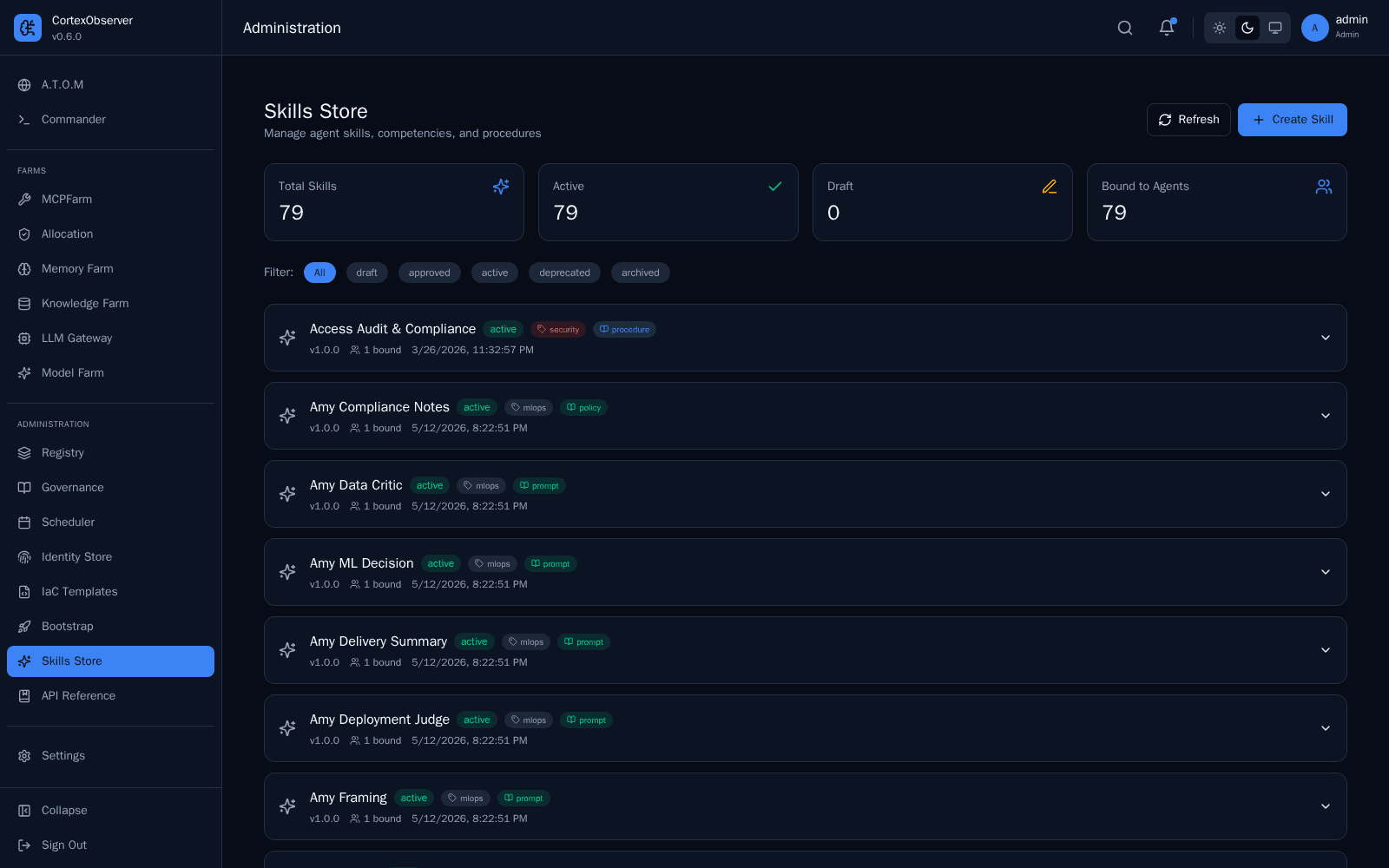
Skills Store — 79 governed, versioned competencies bound to agents
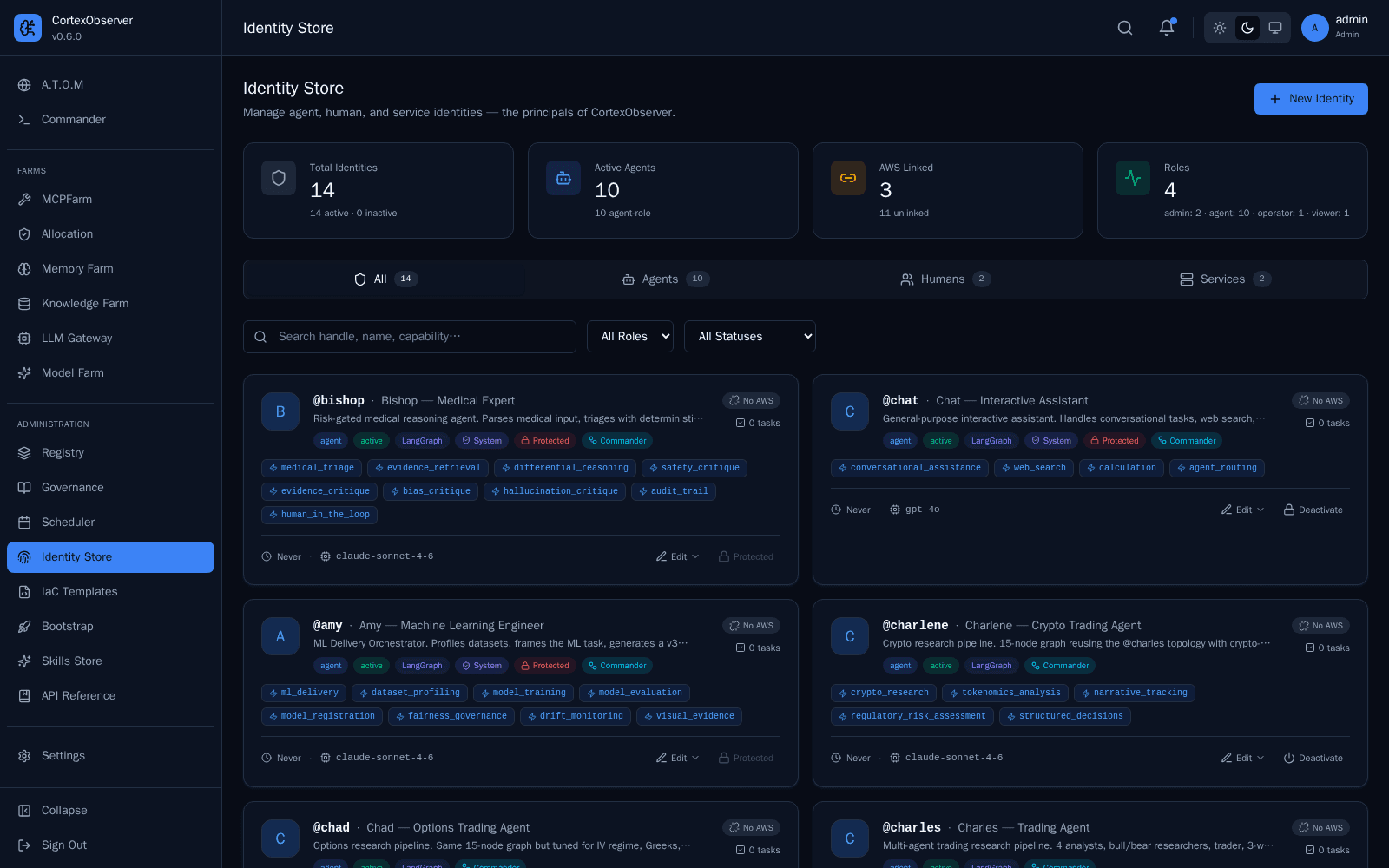
Identity Store — unified agent / human / service principals with RBAC and AWS linkage
Policies → Prompts
Business intent becomes the reasoning context injected into every agent.
Procedures → Skills
How-to knowledge becomes governed, versioned competencies bound to agents.
Standards ↔ Outputs
Applied metadata is verified back against the governing policy — the loop closes.
Risk & Approval Gates
A deploy or a delete pauses for human approval before it runs.
“How it works,” built in
Specialist desks ship their own architecture maps — showing exactly how you, the agents, data, reasoning, and governance connect.
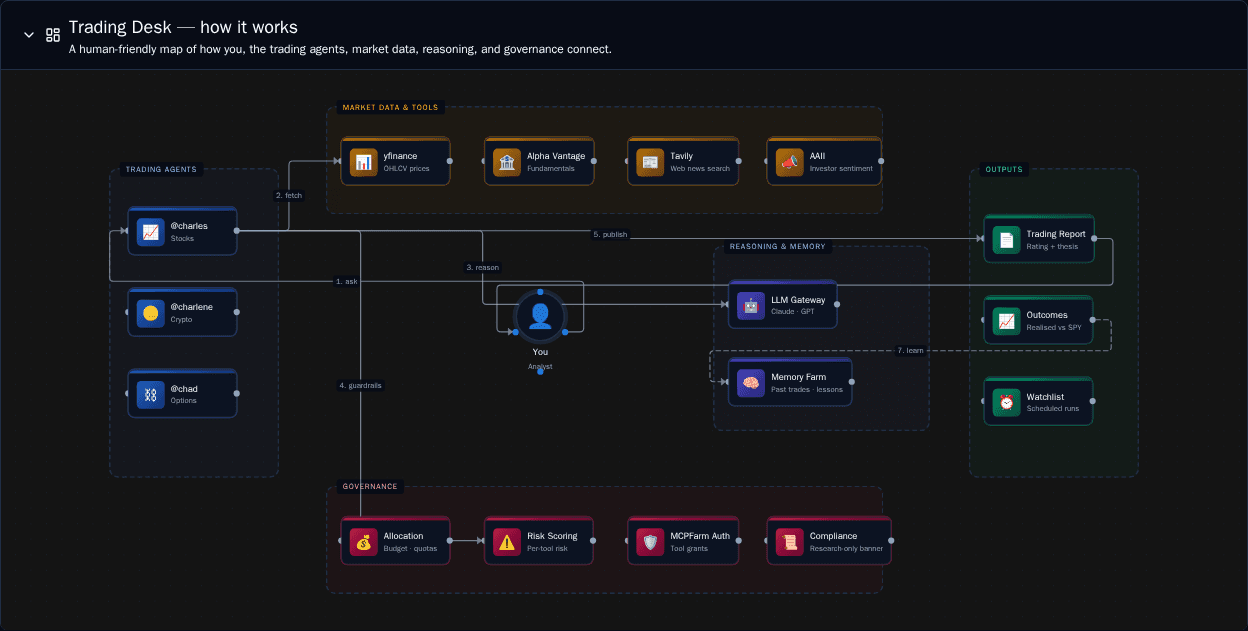
Trading Desk — analyst lenses → bull/bear debate → risk debate → portfolio decision
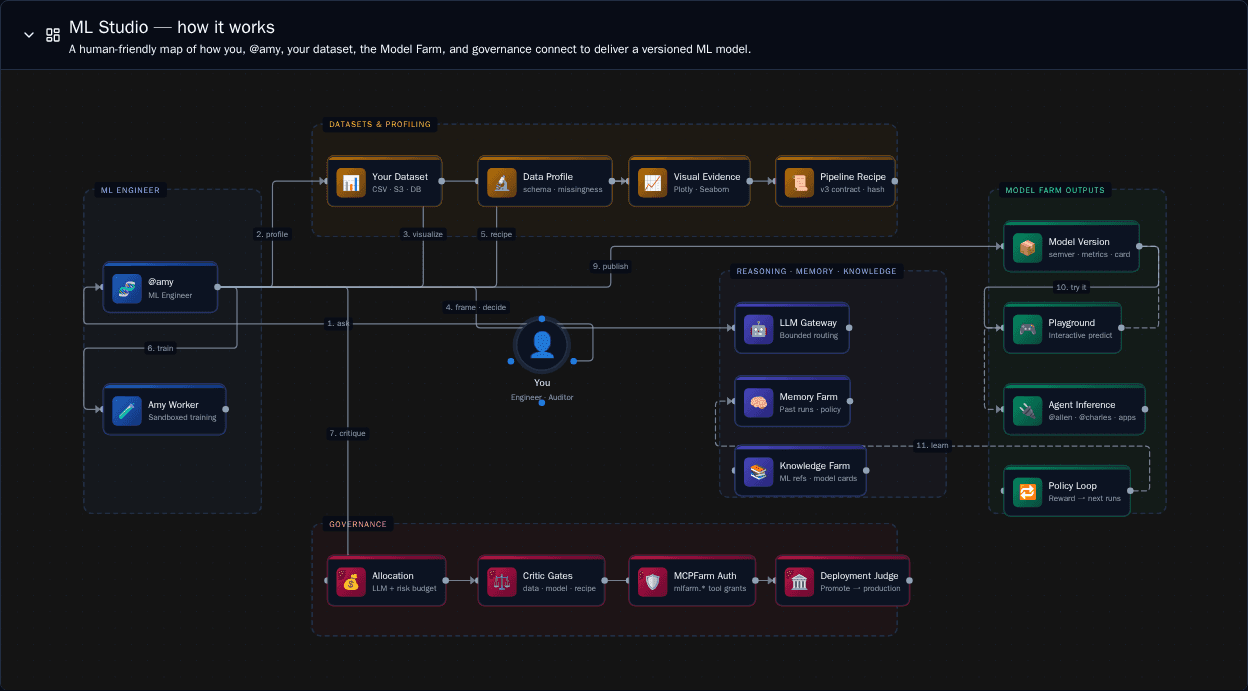
ML Studio — profile → frame → train → critic gates → deployment judge → versioned model
It absorbs the ecosystem
The five projects that came before are no longer separate products — they are now subsystems of CortexObserver. Each still has its own deep-dive page.