5
Reasoning Agents
15
Specialized Tools
5
Tool Categories
∞
Revision Loops
The Five-Agent Pipeline
Each agent is a specialized node in a LangGraph StateGraph. The pipeline flows linearly by default but supports conditional revision loops when quality gates aren't met.
Thinker
Analyzes the problem space, identifies constraints, decomposes complex issues into tractable sub-problems, and establishes reasoning frameworks.
Planner
Creates structured execution plans with task dependencies, resource allocation, and success criteria based on the Thinker's analysis.
Critic
Reviews plans and solutions for logical flaws, edge cases, feasibility gaps, and quality thresholds — triggers revision loops when needed.
Solver
Executes the plan using 15 specialized tools across research, analysis, code generation, and mathematical reasoning.
Judge
Final quality gate — evaluates the complete solution against the original problem statement and scores confidence, completeness, and accuracy.
Revision Loops
When the Critic identifies logical flaws, missing edge cases, or quality gaps, the pipeline routes back to the relevant agent for targeted revision. This loop continues autonomously until the Critic's confidence threshold is met — no human intervention required.
Pipeline Architecture
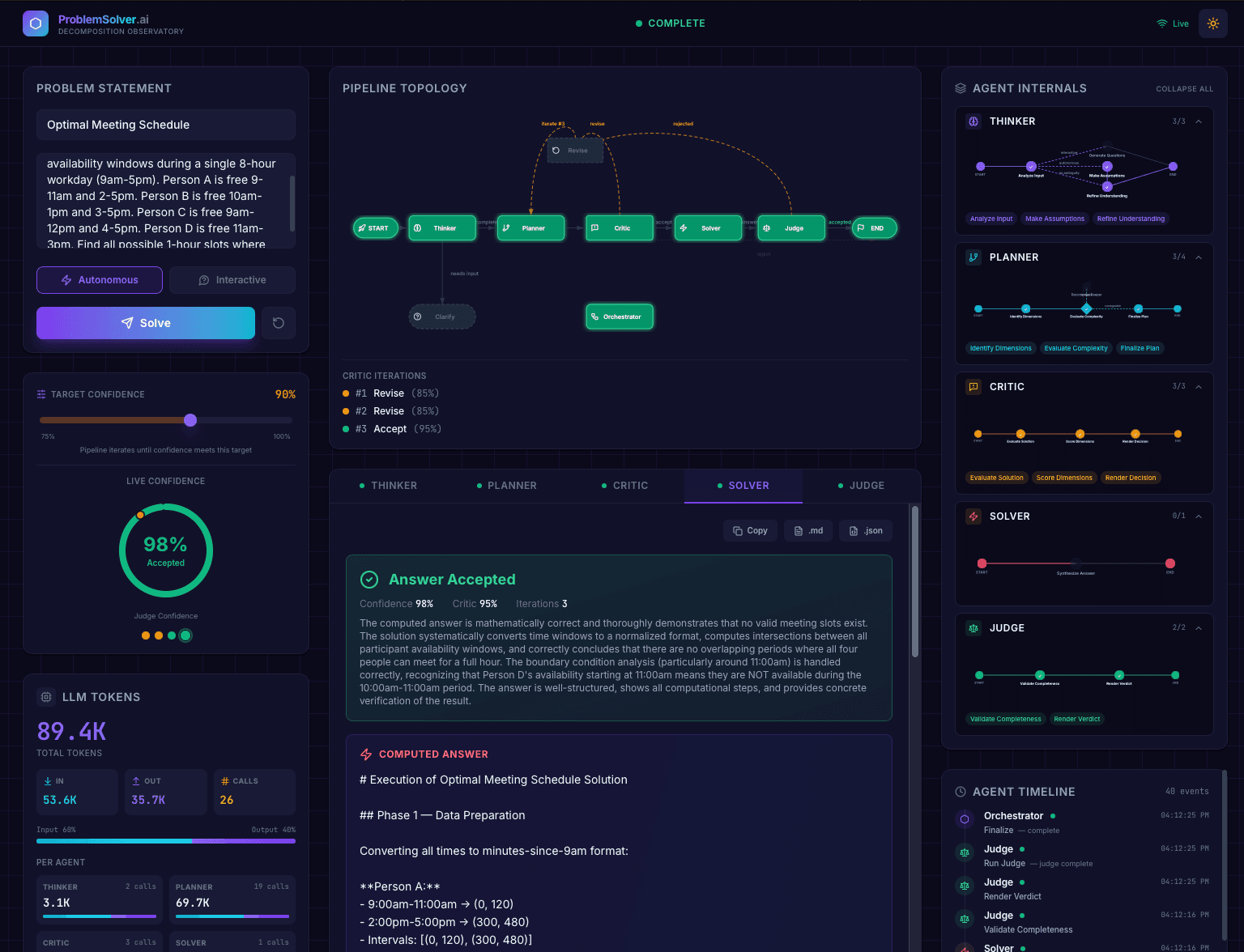
Thinker → Planner → Critic → Solver → Judge — with conditional revision loops
15 Specialized Tools
The Solver agent selects from a purpose-built toolkit spanning research, analysis, code execution, mathematics, and document processing.
Research
- Web Search (Tavily)
- Wikipedia Lookup
- ArXiv Papers
Analysis
- Data Analysis
- Text Processing
- Pattern Recognition
Code
- Python Execution
- Code Generation
- Unit Testing
Math
- Symbolic Math
- Statistical Computation
- Optimization
Documents
- PDF Extraction
- Document Summarization
- Knowledge Synthesis
Key Features
Autonomous Revision Loops
When the Critic identifies quality gaps, it triggers targeted revision loops — the pipeline iterates until confidence thresholds are met, without human intervention.
Multi-Model Reasoning
Supports OpenAI GPT-4o, Anthropic Claude, and Google Gemini as reasoning backends. Each agent can use a different model optimized for its role.
LangGraph State Machine
Deterministic orchestration via LangGraph StateGraph ensures predictable execution paths with conditional branching for revision and escalation flows.
WebSocket Visualization
Real-time pipeline visualization shows each agent's reasoning, tool usage, and state transitions as they happen — full observability into the thinking process.
Deterministic Control Flow
Non-deterministic LLM reasoning wrapped in deterministic graph transitions. Every decision point is auditable, every execution path is testable.
15 Specialized Tools
From Tavily web search to Python code execution to symbolic math — the Solver agent has a purpose-built toolkit for research, analysis, code, and computation.
System Architecture
┌─────────────────────────────────────────────────────────┐
│                   Next.js Frontend                       │
│        WebSocket Visualization · Problem Input           │
│        Real-time Agent Status · Solution Display         │
└────────────────────────┬────────────────────────────────┘
                         │ WebSocket / REST
┌────────────────────────▼────────────────────────────────┐
│                FastAPI Backend                            │
│          Session Management · Tool Registry               │
│          Model Router (GPT-4o / Claude / Gemini)         │
├──────────────────────────────────────────────────────────┤
│              LangGraph StateGraph Pipeline                │
│                                                          │
│  ┌──────────┐   ┌──────────┐   ┌──────────┐            │
│  │ Thinker  │──▶│ Planner  │──▶│  Critic  │◀─┐        │
│  └──────────┘   └──────────┘   └────┬─────┘  │        │
│                                      │        │        │
│                              ┌───────▼──────┐ │        │
│                              │    Solver    │─┘        │
│                              │  (15 tools)  │ revision │
│                              └───────┬──────┘  loop    │
│                                      │                  │
│                              ┌───────▼──────┐          │
│                              │    Judge     │          │
│                              │ (final gate) │          │
│                              └──────────────┘          │
├──────────────────────────────────────────────────────────┤
│  Tool Layer                                              │
│  ┌────────┐ ┌────────┐ ┌────────┐ ┌────────┐ ┌───────┐│
│  │Research│ │Analysis│ │  Code  │ │  Math  │ │  Docs ││
│  │ Tavily │ │ Pandas │ │ Python │ │ SymPy  │ │  PDF  ││
│  │  Wiki  │ │ NLP    │ │ Tests  │ │ Stats  │ │ Summ. ││
│  │ ArXiv  │ │Pattern │ │ Gen    │ │ Optim. │ │Synth. ││
│  └────────┘ └────────┘ └────────┘ └────────┘ └───────┘│
└──────────────────────────────────────────────────────────┘
Why Structured Multi-Agent Reasoning
Single-shot LLM prompting fails on complex, multi-faceted problems. The model tries to think, plan, execute, and evaluate in a single generation — and the quality degrades as complexity increases. Worse, there's no mechanism for self-correction.
ProblemSolver.ai addresses this by decomposing reasoning into specialized agents, each operating within a bounded cognitive scope. The Thinker focuses exclusively on problem analysis. The Planner focuses exclusively on execution strategy. The Critic focuses exclusively on quality assessment. This separation of concerns — borrowed directly from software architecture principles — produces dramatically better outcomes than monolithic prompting.
The revision loop is the critical differentiator. When the Critic identifies a gap, the pipeline doesn't just flag it — it autonomously routes back to the relevant agent for targeted improvement. This mirrors how expert human teams work: specialists iterate within their domain until the quality bar is met, with a final judge providing objective assessment.
By wrapping non-deterministic LLM reasoning in deterministic LangGraph state transitions, every decision point becomes auditable and every execution path becomes testable. This is the same “deterministic control flow with non-deterministic reasoning” pattern that underpins Commander.ai and ml-pipeline.ai — proven at scale across the entire AI ecosystem.
Technology Stack
Orchestration
Models
Backend
Frontend
Research
Infrastructure
AI Ecosystem
ProblemSolver.ai is part of an interconnected ecosystem of specialized AI platforms — each solving a different dimension of the enterprise AI challenge.
Commander.ai
Multi-Agent Orchestration
8 specialized agents with live prompt engineering, scheduling, and analytics — the command center for AI operations.
WorldMaker.ai
Enterprise Digital Lifecycle Intelligence
22 integrated views, 41 endpoints, lifecycle management with MTTD < 0 — visibility and governance across the digital estate.
ml-pipeline.ai
Autonomous ML Pipeline
Raw data to trained model with LLM-powered Critic loops, Optuna tuning, and Neural Observatory real-time dashboard.
MCPFarm.ai
Centralized MCP Tool Governance
Docker-based MCP server orchestration with unified gateway, real-time dashboard, and Python SDK for enterprise tool management.
Implementation Highlights
Separation of Concerns
Each agent handles a single cognitive function — analysis, planning, criticism, execution, or judgment. No agent tries to do everything, mirroring how expert teams operate.
Multi-Model Strategy
Different models excel at different tasks. Route analytical thinking to Claude, creative generation to GPT-4o, and factual verification to Gemini — optimizing cost and quality simultaneously.
Observable by Design
WebSocket streaming exposes every agent transition, tool invocation, and reasoning step in real-time. No black boxes — full transparency into the pipeline's decision-making.
Composable Architecture
Built to integrate with the broader AI ecosystem. Commander.ai can invoke ProblemSolver.ai as a specialized capability. MCPFarm.ai can expose it as an MCP tool. WorldMaker.ai can govern its lifecycle.