The most valuable minute in your enterprise is the one you just lost — the third look at Orreth, and the reason to build it.
We have built enterprises that log everything and understand nothing.
Take one minute of your company. Not a metric about it — the minute itself. Every service and pipeline across your federated cloud estate, every deployment, every transaction, every agent acting and every human deciding. Everything that happened in your enterprise happened inside that minute, and all of it produced output. It exists — scattered across a thousand disconnected systems, in a hundred formats, under no shared identity, with no record of why anything did what it did. By tomorrow, that minute is effectively gone. You paid to produce it. You'll pay again, in incident archaeology and audit season, for having failed to keep it.
Now run a thought experiment. Give every actor in that minute — human, agent, service — a permanent identity. Let each one record its own slice of the minute in a single shared schema, cryptographically signed, carrying not just what it did but the objective and intent it was acting under. Then stack the slices.
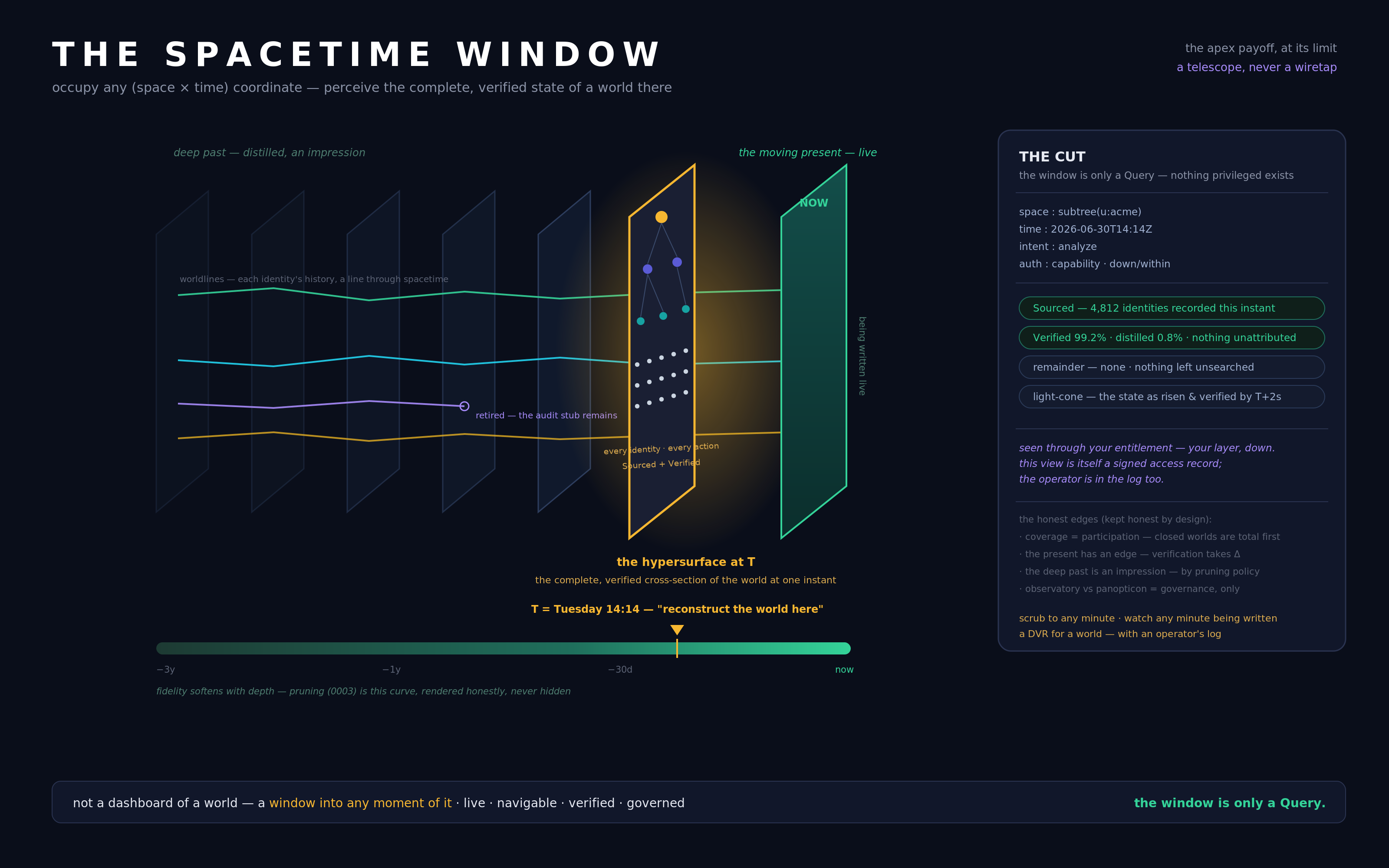
That is not a pile of logs. That is the complete state of a world at one instant — a cross-section of your enterprise you can stand inside. And because this memory does not fade, every past minute becomes a coordinate you can return to. The present is a live feed. The past is navigable. A DVR for a world — with provenance.
That is the spacetime window, and it's the reason Orreth exists.
It is not observability. A dashboard shows you readings from parts you thought to instrument, and when something breaks, the "why" is an archaeology project across systems that never agreed on anything. In the window, why is in the data — every observation is anchored to an identity and stamped with intent, so the same minute answers a security question, a finance question, and an operations question, depending on who's asking and what they're entitled to see. The memory works the way human memory works, minus the limitations: the recent past is pixel-sharp, the deep past is honestly distilled — labeled as such, never silently sharpened — and none of it is trapped in one mind, and all of it can prove where it came from.
If you're a CFO, three things follow. The audit assembles itself: when the regulator asks, the answer is signed end to end — not reconstructed from goodwill and spreadsheets, but attributable at every hop. Incident forensics collapses from weeks of archaeology into a coordinate lookup: reconstruct the business at the moment of the incident becomes a scrub of a timeline, not a war room. And institutional memory stops walking out the door at every reorg and resignation — it compounds, which is to say it finally behaves like an asset instead of a leak. If you're a CEO, the question you've never been able to ask honestly — what did we actually know at 14:14 the day we signed? — becomes answerable, verifiably. If you're a CISO, breach reconstruction is a replay, not a dig.
Now the honesty, because a claim this large earns its skepticism. The window sees only what participates — coverage equals instrumentation and consent, which is why closed worlds get the total window first. The present has an edge — you see the world as its records have risen and been verified, not faster. The deep past is an impression, by deliberate policy — keeping years affordable is what softens them. And the big one: a live window into everything is either the most powerful understanding instrument ever built or the most dangerous surveillance engine ever built, and the only difference is governance. In Orreth, the window is not a privileged god-view. It is only a query — scoped to your entitlement, your layer and down, and every look through it is itself a signed, logged access record. (In the running prototype this is literal: the first pane ships inside the daemon and holds no key of its own — the capability arrives with the viewer, or the glass stays dark.) The watchers are watched. A telescope with an operator's log — never a wiretap. That governance isn't compliance overhead; it's precisely what makes an instrument like this one a regulator can license instead of fear.
Want to feel the ceiling? Picture a persistent game world — a multiverse — where every citizen is born with an identity and every action is recorded from the first frame. Coverage is total by construction. The window becomes the god-view of a living world: scrub to any moment of its history, watch grudges form and alliances break, query the emergent history of a civilization that no one scripted. And pointed at n=1, the same instrument is quieter and maybe dearer: your own life's digital record, un-faded, navigable, and yours alone.
The image above is the concept: the block of a world's history, the worldlines of its identities threading through time, one amber slice lifted out — the complete, verified state of everything at a single instant — and a panel that tells you the most important fact about the whole design: it's only a query.
In the first article I argued that agents need memory that never fades. This is what that memory is for. Not recall — perception. The ability to stand at any coordinate of your world's spacetime and see it whole.
We gave the machines the ability to remember. This is the view from the top of that decision.
Since drafting this, the window stopped being a thought experiment — and then it stopped being a separate pane. In the running Console it lives directly beneath the world it records: a universe of ecosystems and fields turning in orbit, and under it a handle you can pull — the spacetime window rising over the same glass. Time runs toward NOW; every tier of the organization holds its own lane; scrub back and memories arrive as their floors answer, deep history honestly labeled, an un-served band drawn exactly where your entitlement ends. And every render is still a signed, governed query: the capability arrives with the viewer, or the glass stays dark. Stand at the window yourself: demo.orreth.ai — pull the handle at the bottom of the glass.
Originally published on LinkedIn, July 9, 2026.