Why scaling AI is an organization problem, not an intelligence problem — the second look at Orreth.
We have hired a workforce of geniuses and given them no company to work in.
That's the honest state of enterprise AI right now. Everyone is adding "AI employees." The demos are dazzling. Then you try to run fifty of them — five hundred of them — and you discover that what's missing was never intelligence. It's everything else. Who sets policy, and who is bound by it? Who watches cost while everyone watches output? Who approves the risky change at 3 a.m.? Who remembers what worked last quarter, and who makes sure a lesson learned once doesn't have to be learned two hundred more times? And when a credential is compromised, who can end it — everywhere, in one motion?
We didn't forget how to build agents. We forgot to build the company they work in.
Orreth is that company, made executable.
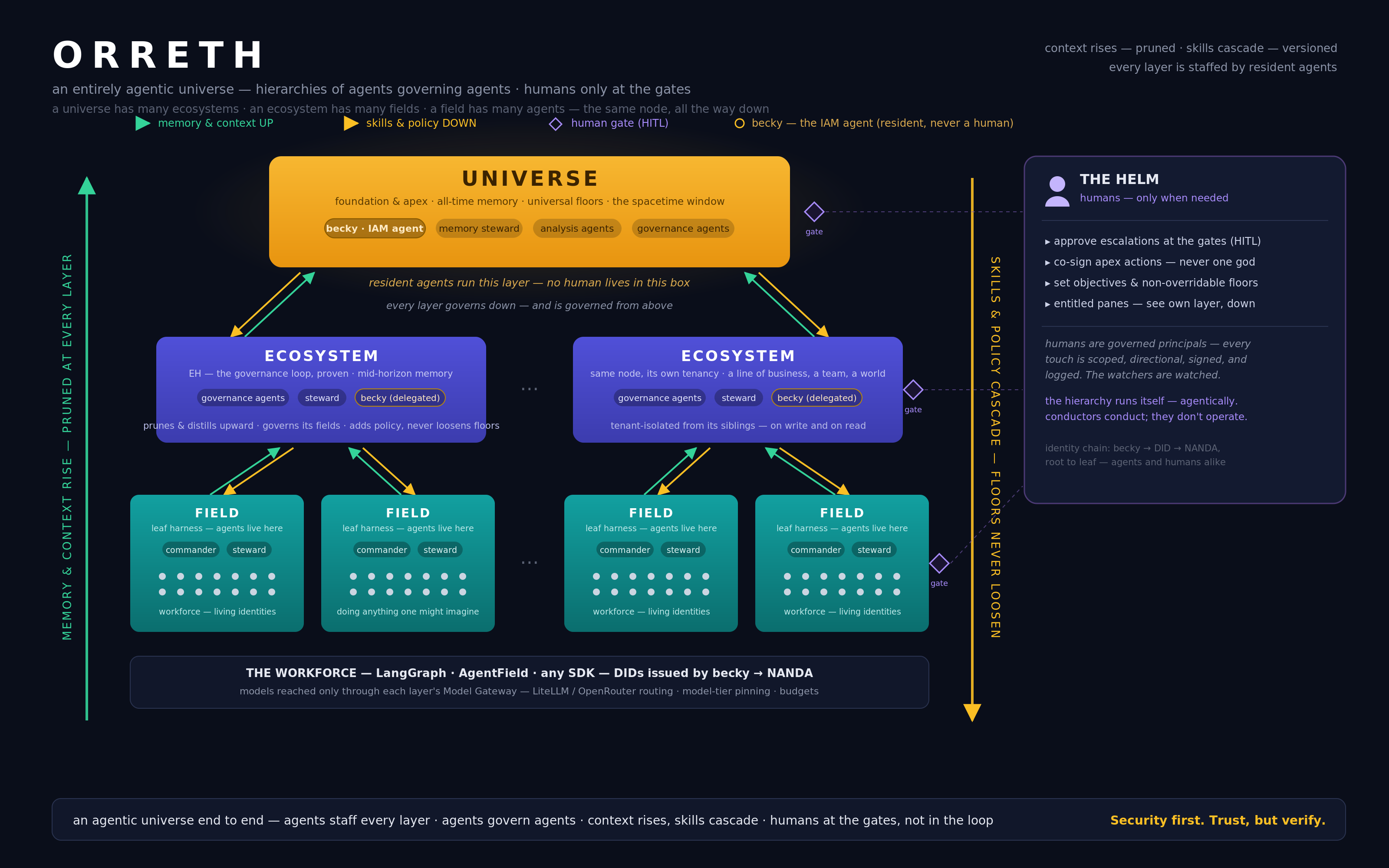
Picture an org chart. A Universe at the top; Ecosystems below it — your lines of business, your teams, your worlds; Fields below those, where the work happens; and inside every Field, the agents doing it. In Orreth this isn't a diagram on a wall. It's one recursive piece of running software, and the tier is just a profile. The same machinery runs the whole company and each division of it — which is exactly how organizations have always scaled, formalized until it executes.
Here's the part most people miss, and it's the heart of the image above: every layer is staffed. Not just the bottom, where the workforce lives — every layer. Each has its own resident agents running the institution itself: a memory steward that curates what the layer learns, governance agents that watch for drift, and an identity agent that issues every credential in the system, from the root of trust down to this morning's newest hire. The workforce does the work. The residents run the company. It is agentic end to end — hierarchies of agents governing agents.
And the humans? At the gates — exactly where a board and an executive team belong. They approve what escalates, co-sign the gravest actions (never one god — the biggest moves require multiple humans, and below that quorum the action isn't forbidden, it's structurally unavailable), and set the objectives and the non-negotiable floors. Every human touch is signed and logged, just like every agent's. The watchers are watched. Conductors conduct; they don't operate.
Two flows keep this organization alive, and they're the two arrows on the image. Context rises — every layer prunes and distills what its teams learned, so only what matters climbs. That's the company learning. Skills cascade down — a lesson captured once becomes a versioned capability every relevant agent inherits. That's the company no longer re-learning.
If you're a CFO, that second flow is the one to stare at, because it's the cost curve bending. You pay for expensive expertise once — a top-tier model, a senior specialist, a hard-won engagement — and what it learned is distilled into a skill that cheaper agents execute, held to the same measured bar as the original. Expertise stops being an operating expense you rent forever and becomes an asset that compounds. And because governance is structural — floors set at the top can be tightened below but never loosened — a rogue desk cannot quietly relax a risk limit. Not "policy says they shouldn't." The system has no mechanism by which they can.
Run the enterprise case: a multi-LOB conglomerate. Each line of business is an Ecosystem, tenant-isolated from its siblings. The apex notices — because it can see across all of them, and nothing below it can — that one LOB's pricing approach is simply better. That skill is promoted, through a human gate, to every LOB. Value discovered anywhere becomes value everywhere. And every number that rolls up to the board is cryptographically attributable to the function that produced it. That's not business intelligence. That's audit that cannot lie about its own provenance.
Now the fun one, because it proves the same machine handles a completely different world: a sports league. The league is the Universe, each team an Ecosystem, each player a permanent identity with a career-long memory. A player gets traded — their identity and career travel with them; the old team's private playbook stays behind. Not because someone remembered to wall it off. Because in this organization, memory belongs to the branch by default and nothing follows an identity by accident. Organization theory, enforced by cryptography.
I've spent nearly thirty years building systems for enterprises, and one lesson never changed: companies don't scale because they hire brilliant people. They scale because structure lets ordinary coordination survive extraordinary growth — clear authority, clear accountability, institutional memory, and an audit trail. Agentic AI is at the "brilliant hires, no structure" stage. The intelligence was never going to be the hard part.
The image above is the org chart of a company that runs itself — agents staffing every layer, agents governing agents, context rising, skills cascading, and humans exactly where humans belong: at the gates, with their hands on the objectives and their signatures on the record.
Since drafting this, the org chart stopped being a diagram. The recursive node runs — one binary where the tier really is just a profile — and a three-tier universe stands up on a laptop with one command, each layer pulling its policy floors from the one above it at boot. The identity agent issues real credentials; the co-sign quorums really refuse. Every employee, worker or resident, wears a meter — tokens and dollars, per agent, rolled to the top. Ask your current AI stack who spent what, thinking about what. This organization can answer — and you can stand in its Console yourself: demo.orreth.ai, a captured moment of a universe that really ran.
Originally published on LinkedIn, July 7, 2026.