Your RAG stack shouldn't be a pipeline. It should be a tournament — with receipts. The seventh look at Orreth: seven retrieval strategies over one governed truth, competing on the record, promoted on a human's signature.
Every RAG diagram you've seen is the same picture: documents in, chunks, embeddings, a vector database, a prompt, an answer out. A pipeline. And pipelines share a quiet assumption — that there is one right way to remember, and your job is to build it.
I think that assumption is wrong, and my system started proving it.
Here's the uncomfortable truth about retrieval: different questions deserve different memories. "What's our refund policy?" wants precision — retrieve wide, re-rank hard. "How is the payment service connected to the fraud rules?" isn't a similarity question at all — it's a relationship question, answered by walking a graph, not measuring distances in embedding space. "Compare our last three postmortems" wants decomposition — sub-questions fanned out and recomposed. One pipeline serves all of these badly and none of them well. The industry's answer has been to pick a flavor per project and argue about it on social media.
We built something different: a library with seven rows, and an organ that knows which row to walk.
One truth, seven projections. The foundation is a rule we refuse to break: the signed, governed log is the only truth, and every retrieval index — vectors, graph edges, everything — is a projection derived from it, rebuildable at will. Seven RAG strategies never means seven copies of your data. It means seven ways of reading one provenanced, access-controlled, deletable-with-receipts record of what the organization knows. Delete a record and it stops speaking in every row at once. Recall a source as poisoned and its words go dead everywhere — not eventually, structurally. Try doing that across seven separate vector stores.
A dispatcher, not a guess. In front of the rows sits a small, deliberately boring organ. It reads each question's shape — deterministically, no model call in the hot path — and routes it by a versioned routing standard: relationship-shaped questions to the graph row, exactness to the reranker, cross-source to the swarm. Two things make it different from an if-statement. First, every choice is a signed record: which row, which rule, why. "Why did this question go to the graph?" is a database query in my system, not a shrug. Second, the standard is data, not code — versioned like a document, revised through a governed proposal process, with a human gate on every change.
And then the tournament. Because here's the move that changes the game: if your strategies are projections over one truth, running all seven against the same question costs almost nothing. So we do. One command — "run the tournament" — races every question through every row, grades each answer on deterministic axes (does the cited evidence actually cover the question? how much signal per token retrieved?), and rolls the results into standings. The scoreboard doesn't average away failures: a row that answered without citations wears a flag, visibly, forever.
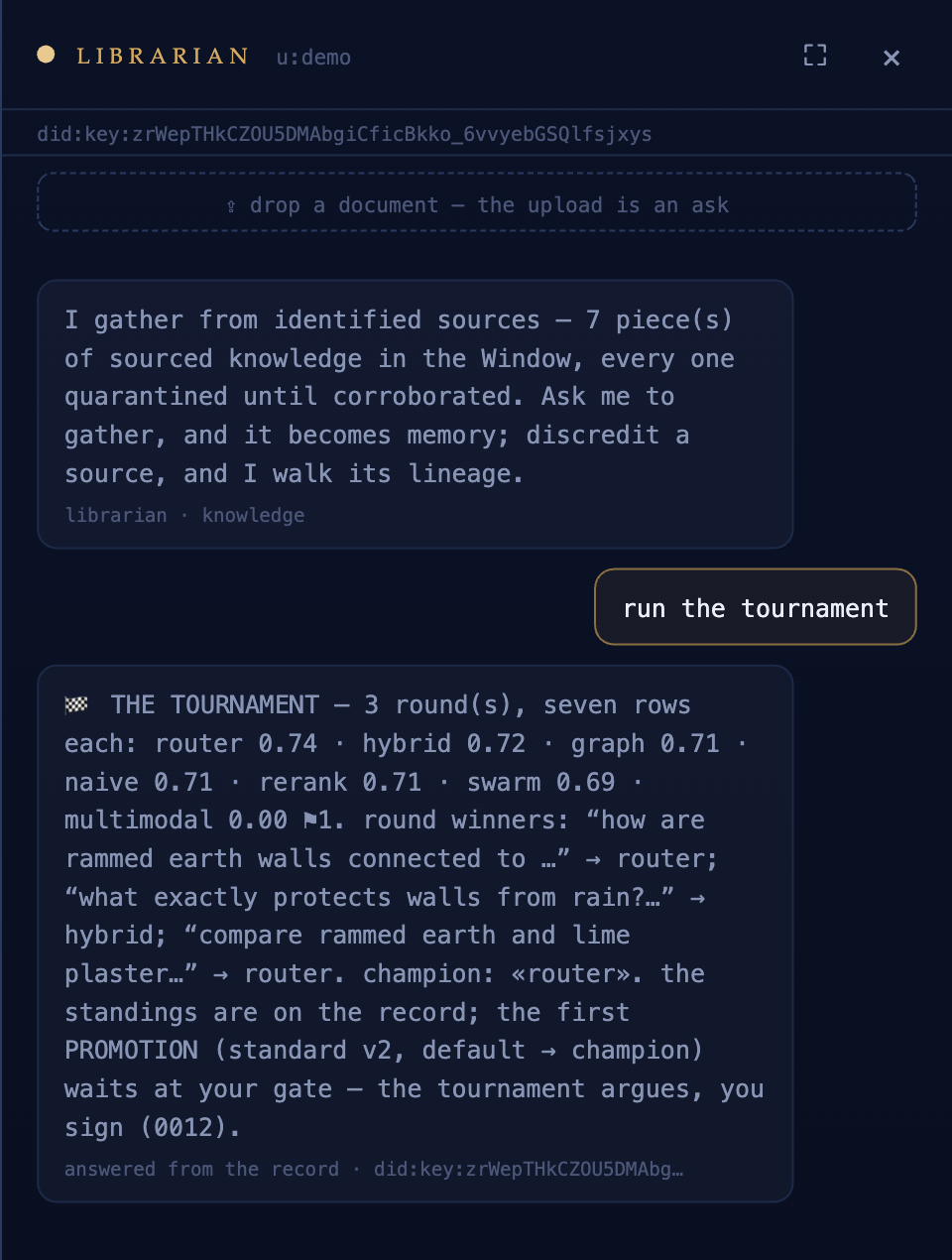
The first live tournament told us things we didn't know about our own corpus. The graph row won overall. The multi-agent swarm won the comparison question. The baseline won a question everyone assumed the graph would take. And the multimodal row scored an honest zero — flagged, not hidden — because there were no images on the shelf yet and it refused to pretend otherwise.
Then the part I care most about. The tournament didn't just report — it argued. It drafted a revision to the routing standard: make the graph row the default; the evidence is attached. And that proposal went where every consequential change in this architecture goes: to a human, with the standings readable, behind a real approve/decline gate. I read the evidence and signed it. The library's default way of remembering changed that moment — not because an engineer edited a config, but because seven hypotheses competed on the record and a human ratified the winner. The old standard still stands behind the new one, versioned, in case the next tournament argues differently.
One more thing landed, and it's the part that makes this more than a retrieval benchmark. The rows stopped serving only their test corpus and met the system's real memory — the knowledge its own research agents had gathered weeks earlier, quarantined at admission, promoted only with corroborating receipts. That trust ladder rides into retrieval: corroborated knowledge ranks fully; quarantined knowledge surfaces dampened and labeled — the answer itself says ⟨untrusted⟩; recalled sources are simply dead. Ask the library a question and the answer arrives wearing its epistemic status. When did your vector database last tell you how much to believe it? Mine told me this morning: the librarian's newest gathering — three findings, fetched minutes ago — sits at trust 0.0000, quarantined, and any answer that leans on it will say ⟨untrusted⟩ to my face until corroboration arrives. That's not a feature I demo; it's the default posture toward everything the system hasn't yet earned the right to believe.
Since I drafted the paragraphs above, the argument stopped being an event and became an institution — three things landed that sharpen every claim in this piece. The scoreboard became an instrument. The seven rows now live as a standing panel in the universe's Observatory, beside the flight recorder and the cost meters — not a report you run but a wall you glance at, with every number wearing a label that says whether it's log-truth or an instrument reading. The grading got an examiner. A new resident — vera, the astronomer, named for the woman who measured what galaxies actually did against what their visible matter claimed — now commissions judges to grade completed answers continuously. Her judges are always another floor's minds (nothing grades its own homework), her spend is metered under her own identity beneath a declared daily ceiling, and the depth of scrutiny is a dial the human turns: glance, watch, assay — depth costs money and says so. And when I stated an objective with a yardstick of my own — "judge this by: one honest line per stall, each named" — the verdict came back scored against my standard and honestly failing it, marked rubric_declared: true. And the argument grew a control group. The router-versus-hybrid question came back as a standing A/B experiment where each arm is a cryptographically named machine — the same floor's fingerprint differing in exactly the asset under test. The split opened on my word, standings rode the signed log join, and when the winner was adopted, the universe's own drift watchdog initially accused the change — because a machine's name had moved without a word it recognized — until the adoption record showed its signature. Even the change-detector here demands a paper trail.
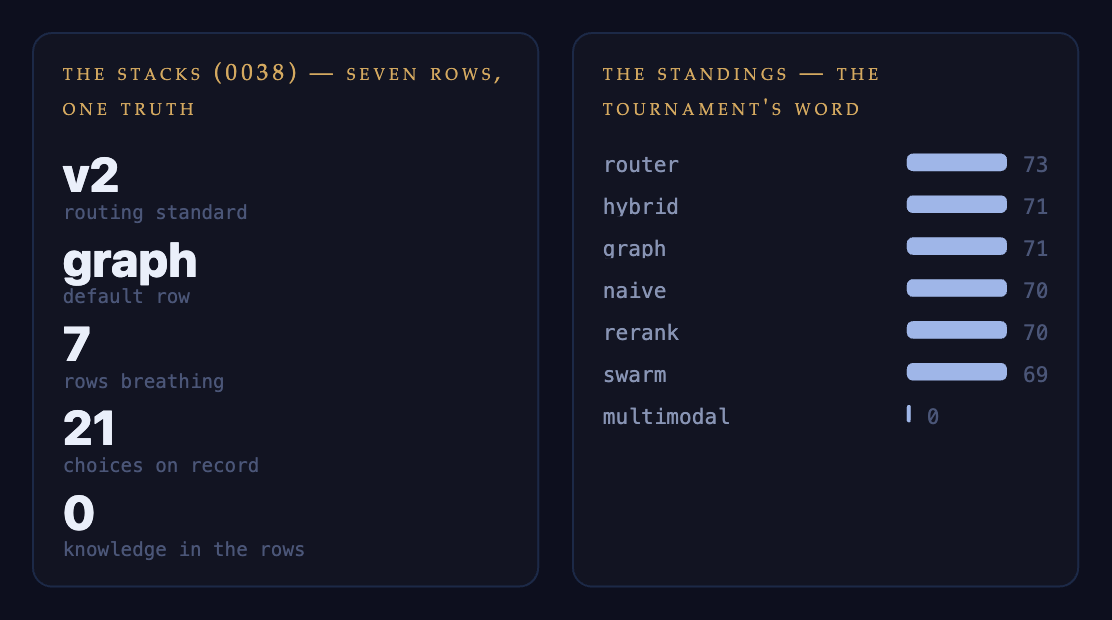
Step back and the loop is closed: ask → route → grade → rank → propose → a human signs. Retrieval that measures itself, argues for its own improvement, and changes only on ratified evidence — with every step a signed record you can walk years later. We've started calling the larger pattern an adaptive, self-improving, living universe harness, and retrieval is just its first organ. The same machinery has already spread: the astronomer's examiner now round-robins every floor of the universe, grading real work under the human's dial.
Seven ways to remember. One truth beneath them. And a library that argues with itself — politely, on the record, loser flagged, winner promoted, human signing.
That's not a pipeline. That's an institution.
Orreth is the memory-and-governance substrate I'm building for agentic AI — where identities persist, memory is signed, and consequence waits for humans. The live tournament, the standings, and the promotion gate in this article are running today on the dev rig; the series index and a public window into the system live at demo.orreth.ai. And since readers keep asking: yes, this build is my résumé — I'm exploring senior agentic-infrastructure and architecture roles; jsbarth.com has the rest.