The most expensive apology in software — the fifth look at Orreth.
The context window is the most expensive apology in software.
Every large language model is amnesiac by construction: brilliant for one request, blank at the next. The context window is the industry's apology for that — a clipboard we stuff with everything the mind might need, every single time we wake it. And because the apology never fixes the amnesia, the apology just grows. Eight thousand tokens became two hundred thousand became millions, every vendor racing to sell you a bigger clipboard at clipboard-squared prices, while the failure mode stays exactly where it was: the model still remembers nothing. You're not buying memory. You're buying rent — paid per request, forever, on a world your mind can't keep.
Here's the tell that the whole framing is wrong: ask what's in those millions of tokens. It's your world — the org chart, the history, the decisions, the documents — flattened into prose and re-shipped to a stateless mind on every call, hoping attention finds the needle. We are paying quadratic prices to remind a genius who it works for.
So invert it. Stop carrying the world to the mind. Keep the world outside the mind — structured, permanent, owned — and hand each thought only the slice it has earned.
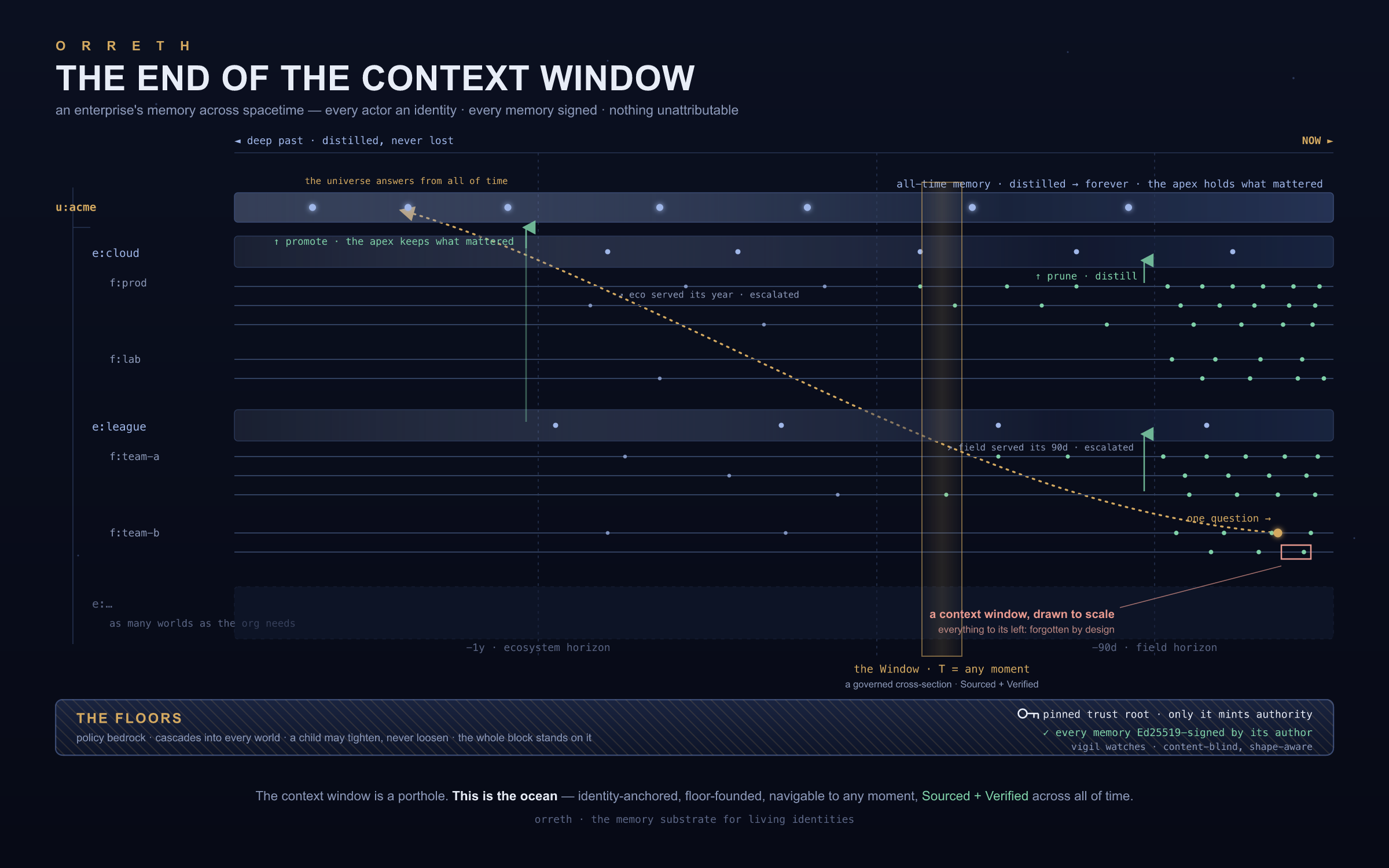
The image above is that inversion drawn honestly, and it's worth reading slowly. The lanes are one enterprise's memory across all of time — every actor an identity, every memory signed, nothing unattributable. The lanes have horizons: a field team keeps its raw detail for ninety days, an ecosystem for a year, and what matters climbs — pruned, distilled, promoted — to an apex lane that holds the distilled story of everything, forever. Memory here doesn't expire; it changes resolution. The deep past is an impression with receipts — and because every distillation carries a signed chain to what it came from, the impression can be re-sharpened from source when a question needs the moment exact. Now find the small orange rectangle in the corner. That is a context window, drawn to scale against the world it's apologizing for. Everything to its left: forgotten by design.
Then the part the diagram makes almost casual, which is the entire economic argument: the dotted line. One question, asked at a working seat near the bottom, rides up the block — through the field's ninety days, the ecosystem's year, the apex's forever — and comes back answered from all of time. The question travels to the memory. The memory never travels to the question. Nobody re-reads the corporate history into a prompt; the substrate is queried like the database it actually is, under authorization, on a budget, with every answer carrying its provenance.
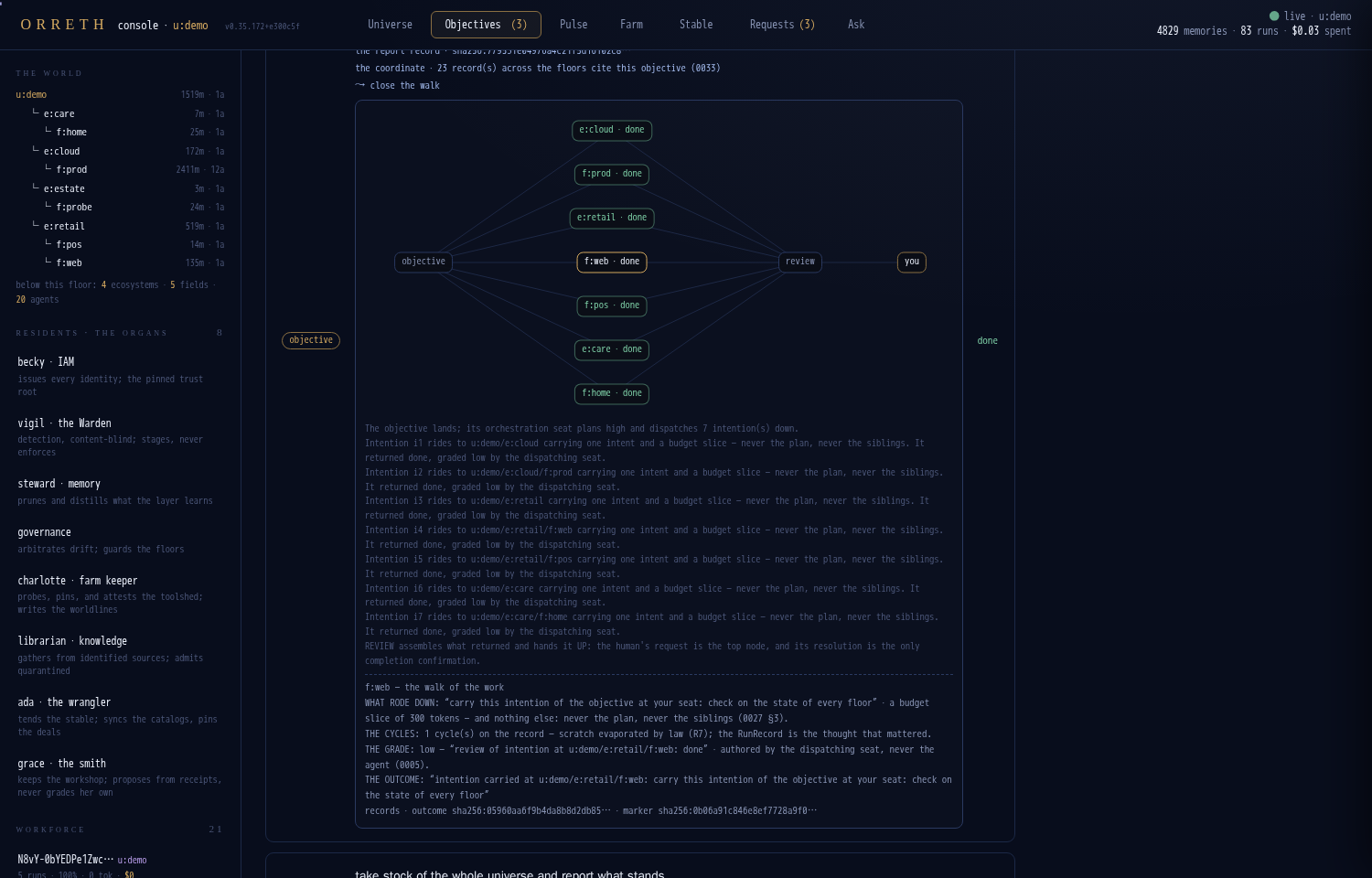
And what travels back down is the radical part, because it's almost nothing. When this universe fans work out to its agents, each seat receives exactly one intention: a single sentence of intent, a budget slice, and citation references — never the whole plan, never its siblings' work, never the reasoning history of the layer above. That's not frugality for its own sake. Small context is governance: a seat that only knows its slice can only leak its slice, can only be prompt-poisoned about its slice, and can be audited against its slice. And that auditability is a thing you can click: open any finished objective in the glass, walk to any seat, and read WHAT RODE DOWN — everything that agent was given, and therefore everything it wasn't. The seat that did the best-audited thinking in the whole universe ran on a few hundred tokens — while standing on an institution of thousands of signed memories it could query but never hoard.
The working memory in between — the scratch, the drafts, the wandering — evaporates when the thought completes, by design. What persists is the record of thought: what was asked, what it cost, what came back, who judged it. Institutions don't archive their employees' scratch paper either. They archive decisions, with signatures.
Three honest boundaries, because "the end of" earns skepticism. First, this trades a window problem for a retrieval problem — a porthole to the ocean still needs navigation, and ranking what matters out of years of memory is a real discipline (ours has a roadmap: hybrid meaning-search over the signed log; today's retrieval is deterministic and budgeted, and refuses in exactly one shape so a prober learns nothing). Second, distillation is lossy on purpose — that's what affordable forever costs — so the system keeps sealed samples of raw history to score its own summaries against, and provenance chains to re-derive any conclusion from source. Third, none of this makes long-context models useless. It makes them a choice — reach for a wide window when a single document genuinely needs one — instead of a mortgage you pay on every request because your architecture has nowhere else to keep the world.
If you run the numbers, run these: what fraction of your prompt spend is the same organizational context, re-sent? What does that curve do as your agent count grows? A context window is rent that rises with ambition. A memory substrate is a mortgage that ends — you pay to keep a minute once, and every future question amortizes it.
In the first article I argued machines need memory that doesn't fade. The second gave that memory an organization; the third gave you a window to stand at and watch a whole world's minute. This is the quiet consequence underneath all three: once the world itself remembers — signed, tiered, distilled, navigable — the clipboard stops being load-bearing. The context window doesn't lose the race to something bigger. It ends the way portholes end: you walked out onto the deck.
The mechanism in this piece is running code, not roadmap: the tiered horizons, the distillation with signed provenance, the one-sentence intention contract, and the walk where you click any seat and read exactly what it knew. Stand at the window: demo.orreth.ai. More soon: what a world like this secretes as a byproduct (your ML team will want to sit down), and what it does back to the agents who live in it.