Put an agent on every critical business function — ten thousand of them — and the question that decides everything isn't how smart they are. It's what they remember, what they can prove, and what it costs to recall it in year five.
Here's an uncomfortable audit of your company: its real memory doesn't live in your systems. It lives in inboxes, in hallway context, in the heads of people who might resign on Friday. Every enterprise runs with institutional amnesia and has simply priced it in — re-discovered decisions, re-fought arguments, re-learned exceptions, the deal knowledge that walked out with the account manager.
Now run the experiment everyone is about to run: an agent for every critical business function. One for accounts payable. One for claims. One for procurement, onboarding, incident response, pricing, quota planning, vendor risk. Not ten agents — ten thousand, each seated by the small, fast kernel I described in the lead article, the way applications stand on an operating system. The vendors will sell you the intelligence. Almost nobody is talking about the layer underneath, the one that decides whether this fleet becomes an asset or a liability:
memory.
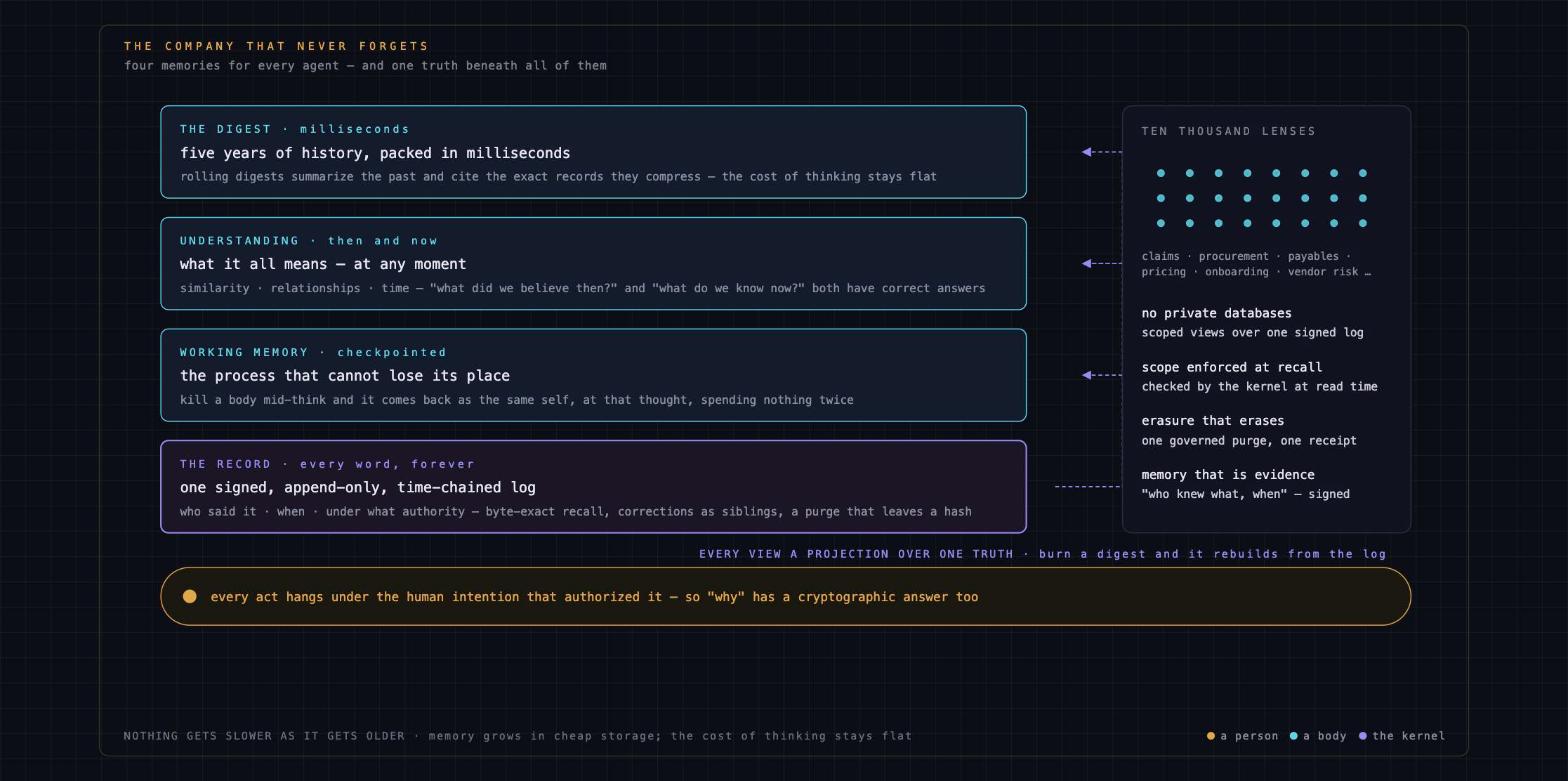
The kernel gives every agent four memories — and one truth beneath all of them.
The record: every word, forever. Everything an agent reads, decides, says, or is told lands as a signed, tamper-evident, time-chained entry in one governed log. Not a summary of it — every word, with provenance: who said it, when, under what authority. So when the human asks the claims agent, "repeat exactly what that adjuster's note said in March," the answer is byte-exact, not a paraphrase. Your agents are not human-like employees who half-remember. They are institutional memory with a work ethic. Recall is a guarantee, not a retrieval lottery.
Working memory: the process that cannot lose its place. An agent's work is checkpointed at every step on the kernel's ground. Today that is proven at the scale of a single thought: kill a body mid-think and it comes back as the same identity, at that thought, spending nothing twice. The same mechanism carried to a quarter-close that runs a thousand steps across a dozen systems — kill the machine at step 700, the agent resumes at 700, still owing exactly what it owed — is a named row on our build line, with the kill-it-and-watch walk that proves it. Business continuity stops being a binder and becomes a property of the runtime.
Understanding: what it all means — then and now. On top of the record sit meaning-shaped indexes: similarity, relationships, and time. Because every entry is immutable and chained, "what did we believe then?" and "what do we know now?" are both first-class questions with correct answers. Regulators ask precisely this. So do litigators. Most companies reconstruct it from email archaeology; here it's a query.
The digest: five years of history, packed in milliseconds. This is the economics nobody prices until year three. A naive agent's context — and your bill — grows with everything it has ever seen. Ours compresses: rolling digests summarize the past and cite the exact records they compress, so an agent packs "the short version" instantly while every word underneath stays one door away. Memory grows linearly in cheap storage; the cost of thinking stays flat. An agent in year five answers as fast as it did in week one, and nothing was thrown away to make that true.
Four memories — but the enterprise power comes from the laws that bind them:
One truth, ten thousand lenses. Those agents do not have ten thousand private databases. They have scoped views over one signed log. No sync drift. No shadow copies breeding in corners. And the consequence your privacy office should love: erasure that actually erases. A governed purge cascades everywhere at once — the record, the indexes, the digests, the caches — with a receipt. Right-to-be-forgotten across ten thousand agents becomes one auditable act, not a quarter-long hunt.
Scope enforced at the moment of recall. The fraud agent and the claims agent share exactly what policy allows — checked by the kernel at read time, every time, not by naming conventions and good intentions. An agent's memory can be broad; its recall is always governed.
Memory that is evidence. Because every entry is signed and chained, "who knew what, when" — the question at the center of every dispute, audit, and post-incident review — has a cryptographic answer — and because every act hangs under the human intention that authorized it, so does "why." Your fleet's memory isn't just operationally useful; it's discovery-grade.
Nothing gets slower as it gets older. A law we enforce structurally: no operation ever sweeps the whole corpus. Recall is indexed, consolidation rides events, digests bound the context. The fleet's memory in year ten behaves like year one — which is the difference between an architecture and a demo.
Step back and look at what that adds up to. An enterprise where every critical function has a mind that never forgets, never leaves, resumes mid-process after any failure, answers point-in-time questions honestly, forgets only on governed command — and proves all of it. Institutional knowledge stops evaporating with turnover and starts compounding like capital. That's not an AI feature. That's a balance-sheet change.
Ten thousand brilliant agents with vendor-default memory is ten thousand liabilities that happen to be articulate. Ten thousand ordinary agents on a governed memory kernel is the first company in history that actually remembers what it knows.
The intelligence will keep getting cheaper. The memory — governed, provable, flat-cost, erasable-with-receipts — is the moat.
Orreth is an agentic architecture governance kernel, built in the open. I'm exploring senior strategy and architecture roles in agentic infrastructure — say hello.