Why agentic AI needs memory — not a bigger window. An introduction to Orreth.
We have built agents that reason like specialists and forget like goldfish.
Ask one to solve something hard and it will impress you. Come back tomorrow, restart the process, and it has no idea the conversation ever happened. Everything it "knew" lived inside a context window — a fixed budget of text we stuff in front of the model — sitting on top of training data frozen months in the past. The window is the boundary of the agent's world. When the process restarts, the world resets.
For two years the industry's answer has been the same: make the window bigger. More tokens, longer contexts, larger budgets. I think that's the wrong axis entirely.
Here's the parallel that reframed it for me. As humans age, our memories fade, and we treat that as a quiet tragedy. An agent is worse off than an aging human — it isn't slowly losing its memories, it never had any. It is only ever as good as the data that fits in its window right now. Bounded by time. Erased on reboot.
So the real question isn't how big should the window be. It's why is the window the memory at all.
The reframe: the running system is the memory.
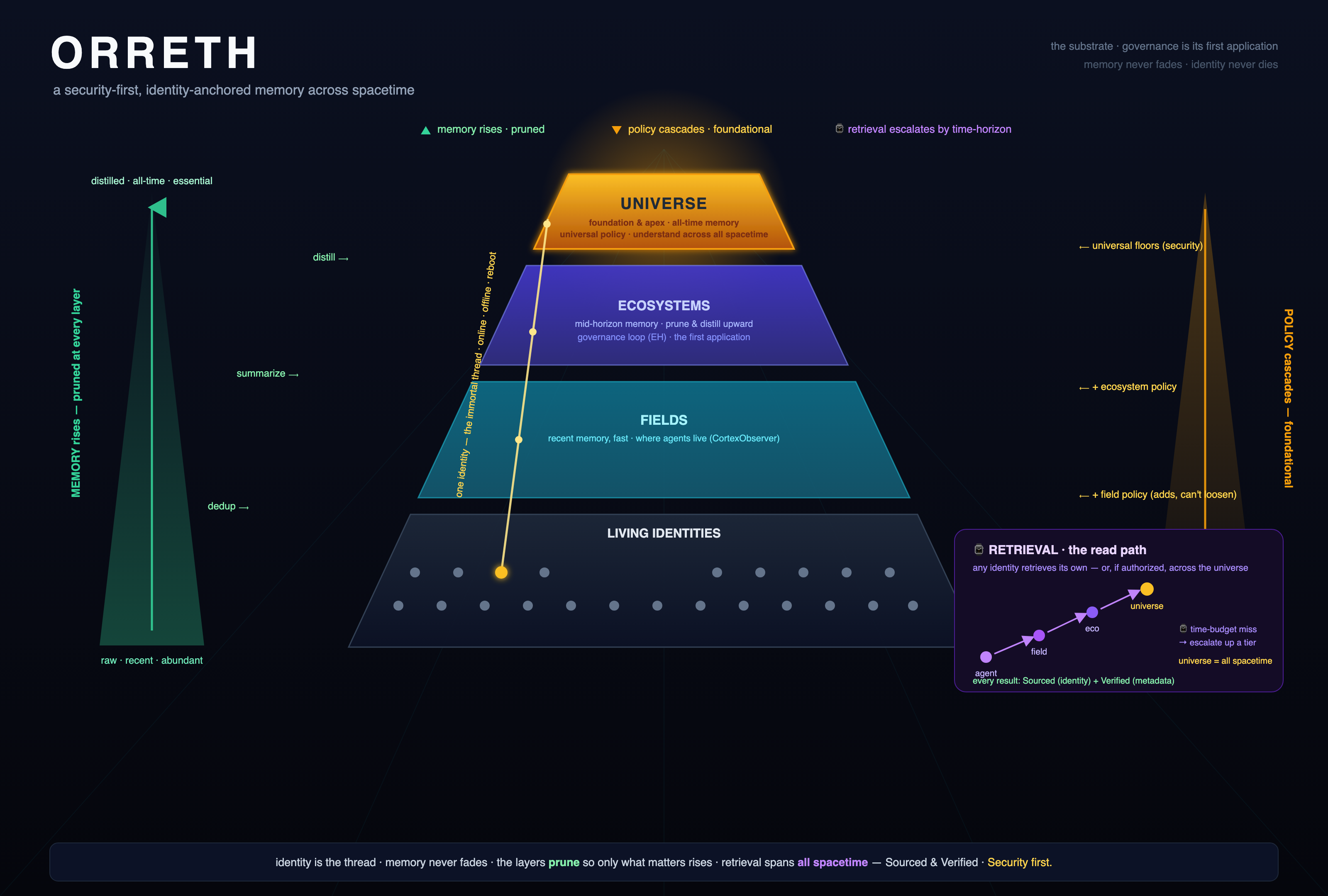
Not a bigger window — a substrate. A living system where memory is durable, keyed to identity, retained for years, and retrievable across the entire estate of agents rather than trapped inside one process. I'm calling it Orreth, and it's the next lift after CortexObserver, the agent-governance system I built before it.
Three ideas hold it up.
One — identity is the thread. An agent's process is disposable; it's online, then offline, then rebooted. What should not be disposable is who it is. In Orreth every agent has a permanent, unique identity, and memory is keyed to that identity, not to the running process. Reboot is no longer death. The process is the incarnation; the identity is the thread that carries a lifetime of experience across every restart.
Two — memory rises, and is pruned. Raw experience is abundant and mostly noise. So memory flows upward through the system — agent to team to business to the top — and at every layer it is deduplicated, summarized, and distilled. Only what's worth keeping survives the climb. This is what makes "remember for years" affordable rather than a storage nightmare: the higher you go, the more distilled and the more valuable the memory becomes.
Three — retrieval spans space and time. An agent can recall its own history — or, when authorized, draw on the collective memory of every identity in the system. Recent memory is served locally and fast; deeper history is reached only when a query needs it. Knowledge stops being something you cram into a window and becomes something you retrieve — the relevant slice, across the whole system, across all of time.
And here is the part I care about most, because it's the part everyone skips: a memory that spans identities and time is a security problem before it is a feature. A system that can recall anything is also a system that can leak anything. So in Orreth, every memory is cryptographically attributable to the identity that created it — sourced — and every retrieval is verified and access-controlled. One tenant can never read another's private memory. The broadest, most powerful queries require the highest authority. Retrieval isn't a convenience bolted on at the end; it's the most sensitive surface in the whole design, and it's governed like one. Security first. Trust, but verify — now across an entire ecosystem, and across time.
Governance, notably, is the first application of this — not the point of it. Once the system remembers what its agents did and how well it worked, it can tune them: promote what succeeds, correct what drifts, and hold a human at the helm for the decisions that matter. But that's downstream. The foundation is the memory itself.
Now the implication I'll only gesture at here.
Once an agent's knowledge lives in a durable substrate and is retrieved on demand, the context window stops being the boundary of what the agent knows. It becomes a working set — scratch space for the task in front of it — not the limit of its world. The window doesn't need to hold an agent's memory, its history, or its collective knowledge, because none of those live there anymore. They live in the substrate, and the window borrows only what the moment requires.
That quietly dissolves the constraint we've been throwing hardware at: the time boundary (memory that outlives any session), the isolation boundary (one agent's window versus a whole system's recall), and the waste of re-deriving what the system already learned. The bigger-window race is a race to a ceiling. The substrate removes the ceiling.
I've spent twenty-five years designing systems that had to work at scale, under scrutiny, and without surprises — transaction pipelines, identity platforms, the unglamorous machinery that fails quietly or not at all. The lesson that stuck: the hard part is never the intelligence. It's the memory, the identity, and the trust boundaries around them. That's exactly where agentic AI is thin today, and exactly what Orreth is built to make solid.
We gave the machines the ability to think. It's time we gave them the ability to remember — and did it the right way, so that what they remember can be trusted.
Orreth is now running code: a three-tier universe on one laptop, every memory signed, every identity permanent. Watch it live: demo.orreth.ai.
Originally published on LinkedIn, June 30, 2026.