Why the best agent you've deployed is the worst it will ever be — the sixth look at Orreth.
We deploy our smartest agents at their peak and call the decay maintenance.
That's the quiet truth under every agent platform today: the day it ships is the best day of its life. Its prompt was tuned against last month's world. Its knowledge was frozen at build time. Whatever it figures out in production dies with the session, and the only way it ever gets better is that a human takes it offline and operates on it. We don't run agents. We run taxidermy with API access.
The industry's answer is a bigger model. But an agent is not its model — an agent is a loop over what it can reach. Freeze what it can reach and you have frozen the agent, no matter how brilliant the mind you rent for each step. Which suggests the inversion nobody is building for: keep the loop fixed — and let the world it reaches grow.
That is the whole design, so let me say it precisely.
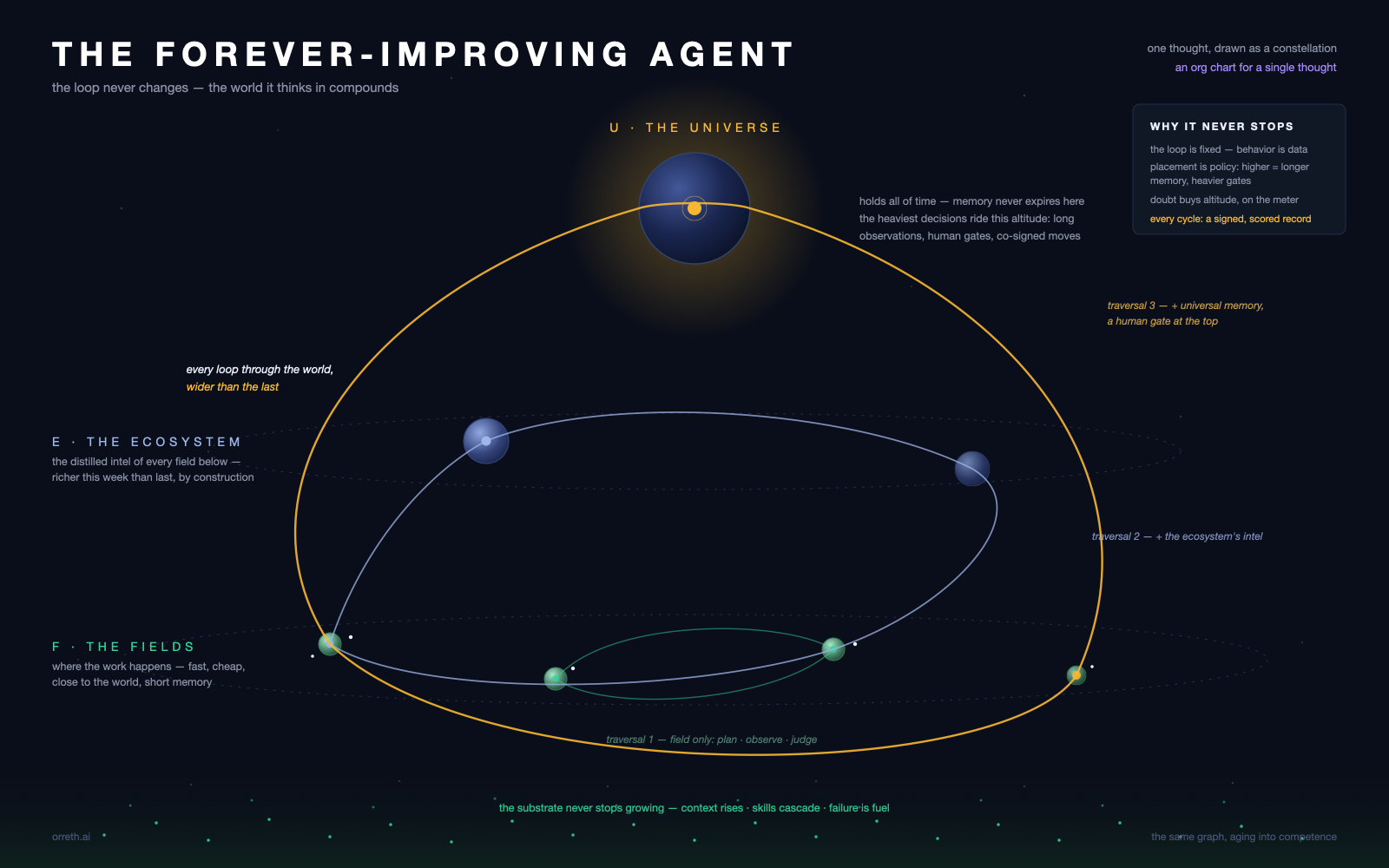
In Orreth, every agent runs the same loop — plan, observe, judge, answer or retry — and the loop never changes; persona, skills, objectives, and budgets arrive as data. What's new is that the loop's steps have altitude. An agent's flow is not a flat program; its stages ride different tiers of a living organization. Field nodes sit close to the work: fast, cheap, short memory. Ecosystem nodes see what no field can — the distilled intelligence of every field below them. Apex nodes hold all of time. And placement is policy: the bigger the decision, the higher it must ride — longer observations, heavier governance, human gates. A popular framework gives you a flowchart. This is an org chart for a single thought.
Now watch what happens as that thought loops, because the ground under it will not hold still. Context rises — every layer prunes and distills what its teams learned, so the ecosystem's intel is richer this week than last. Skills cascade — a lesson captured anywhere becomes a versioned capability everything below inherits. Knowledge compounds with receipts — gathered from identified sources, quarantined until corroborated, recallable to the root if a source goes bad. And failure is fuel, literally: when an agent cannot finish an objective, the unsolved intent is parked as a knowledge assignment; a librarian gathers what was missing; and the retry runs on knowledge the failure itself commissioned — automatically, on the record. When the agent's own critic doubts, doubt buys altitude: the next cycle thinks one class higher, at a cost the meter shows to the decimal.
So the agent improves without a single line of it changing. Not because it retrains — because the world it thinks in compounds. The same graph, run in March and run in November, is a different mind in exactly one way: November's universe remembers more, has distilled more, has crystallized more of what worked into skills — and can prove every step of how it got there. The flow ages into competence the way an employee does: same person, richer institution.
I drafted that argument three weeks ago as a design claim. In the weeks since, the system started doing it to itself — and because everything here is signed, I can show you the receipts.
First, the craft itself became versioned property. Every prompt, policy, and skill in the universe is now an asset with a lineage — proposed as a sibling version, never a silent overwrite, graded into severity lanes, and adopted at a human gate with the diff in hand. When an agent gets better here, you can read exactly what changed, who proposed it, what evidence backed it, and who signed it. Improvement stopped being a deploy and became a paper trail.
Then the improvement loop closed on something real: retrieval. The universe runs seven retrieval strategies — naive, rerank, multimodal, graph, hybrid, router, swarm — as seven projections over one signed truth, and a tournament races them against real questions, graded on information-theory axes none of them control. The first tournament's standings argued that the routing standard itself should change. That argument arrived at my gate as a versioned proposal — evidence attached, old standard kept behind it — and my signature, not a metric, made it law. The system found its own better way of remembering, made its case, and waited for a human. Ask → route → grade → rank → propose → a human signs.
And then the part I'd been promising CFOs actually happened: the first graduation. A piece of craft learned at the expensive model tier was crystallized into a skill, canaried at the cheap tier, confirmed by the standings — and only then allowed to serve there, with the refusal path and the demotion path proven beside it. Expensive expertise, learned once, now executes on a model that costs a fraction — at the same measured bar, on the record. The rule that governs the whole pipeline is four words long: never silently dumber. In either direction.
If you're a CFO, this is the depreciation curve flipping. Today an agent is a wasting asset — it decays toward irrelevance and you pay to rebuild it. Here the flow appreciates: expensive expertise gets learned once, graduates to cheaper models at the same measured bar, and the per-agent meter — tokens and dollars, rolled to the top — shows you the curve bending. Maintenance stops being surgery on a frozen artifact and becomes what it is in every healthy organization: the institution getting better underneath everyone in it.
Three honest boundaries, because "improves forever" earns its skepticism. It improves only within its entitlement — the growth is governed, floors tighten downward, and a field-level flow can request altitude but can never smuggle an apex decision into a field node. Nothing grades its own homework — every cycle lands as a run record signed by a scribe, never the agent, scored against declared objectives and pinned to the exact policy that governed it, so "it's getting better" is a measurable claim about signed history, not a vibe. And forever means as long as the universe lives — which is the point: memory is keyed to identity, not process. Reboot is not death here. The agent that wakes tomorrow is the same self, standing on everything it and its institution have ever verified.
The attached image is the shape of it: one agent's thought drawn as a constellation threading the tiers of a living universe — small fast nodes among the field moons, a heavier one riding the ecosystem's intel, one deliberate node burning at the core where all of time lives — and every loop through the world wider than the last, because the world it loops through never stops growing.
In the first article I argued machines need memory that doesn't fade. In the second, that they need an organization to work in. The window showed you that world whole. This is what the world does back: it makes everything that lives in it better, forever, on the record.
Everything in this piece is running code, not roadmap: the fixed loop, the versioned craft with its human gates, the seven-row tournament and its signed promotion, the graduation pipeline with its canary — 254 conformance tests hold it honest across two implementations. You can watch the institution it grows in: demo.orreth.ai — a captured moment of a universe that really ran, and it greets you as a living brain. Next in the series: what happened when the library started arguing with itself.
A personal note: Orreth is a solo build — architecture, code, and governance design over one intense year — and it doubles as my résumé. I'm exploring senior roles in agentic infrastructure and AI systems architecture. If your team is building the institutional layer underneath the agents, I'd genuinely like to talk: jsbarth.com.